Saturday, July 16, 2005

Weekend Cat Blogging 6

I recently discovered Clare's blog from Sydney and was enthralled with the pictures of her bee-yoo-ti-ful cat, Kiri. She has also started this weekend cat blog, where you get to share pictures of your cats (so please join us) and wow, those cat pictures are also cute. I always have quite major problems taking my kitties' pictures as they're just not the kind to sit and let me snap them. I'm slowly building a collection of their pictures as and when they're in the mood to sit still.

Quite a number of people have been curious about my nickname boo_licious and one person actually asked Splashie Boy if it was short for booty_licious! To clarify matters up, it's just a mix of my cat's name, boo and the word delicious. I had to add the underscore as Blogger would not take boolicious since it was registered before.

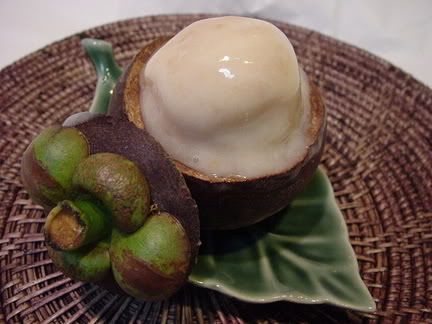
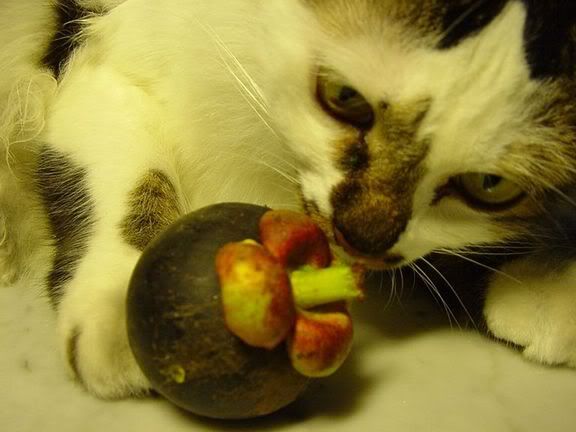
Here's boo playing with a mangosteen she nicked from the plate when I was photographing the fruit for my salad entry. Ever so curious, she was fascinated with the smell and the shape. In fact, she wanted to play with it like one of her balls. Being the youngest cat in the household, she gets away with murder and is extremely "manja" (Malay for pampered, I think this is the translation as my Malay is hopeless). An interesting fact about her name, she actually picked it out herself. The story goes....when she was a small kitten, she loved to sit at the space between my LCD screen and the computer keyboard. One day, she stretched and touched the keyboard and accidentally typed the word "boo" on my MSN Messenger so we decided to name her that. She still likes to sit at that little space even though it is a tad cramped since she has grown so big already.

Image hosted by Photobucket.com

Friday, July 15, 2005

SHF 10 - Honey Mousse with Honey Mango Sauce

It's Sugar High Friday today, the event which originated from the Domestic Goddess that gives me the perfect excuse to try out something sweet. This month, it is hosted by Nic from baking sheet and the theme is Honey.

I am pretty excited as it's my first time participating in this event. Moreover I rarely use honey for my desserts that I was itching to try a new thing. I usually keep honey in my larder to drizzle them over my porridge oats or when I am struck down by the flu bug. Nothing cures me better from those flu aches and pains than a cup of hot honey and lemon.

I thought for a long time on what I wanted to make - should I make a honey cake, a honey tart, a honey biscuit, indulge in some nougat or pannetone? Well, I finally settled for a simple honey mousse which sounded dreamy with it's white chocolate and cream base. It looked a bit plain so I decided to top it up with a sauce made from honey and fresh mango puree. Perfect combination as the sauce complemented the creamy sweet mousse. Splashie Boy loved it so I reckon I'll be making more of this in the future.

The only downer was my mousse was a bit soft, not sure if my proportions of the gelatine were enough as I did halve the recipe to suit the two of us. It was also my first time turning out my mousse from the ramekin, so that took a bit of juggling but it came out perfect albeit a bit wobbly.

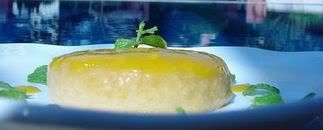
The other challenge was taking a picture of the mousse, it looked plain and Splashie Boy said it resembled a hamburger! My apartment does not get much natural light so I decided to take my dessert outside and took a snap at the poolside. It created an interesting effect as there was a reflection at the pool on top and the light seemed to just highlight my mousse.

Image hosted by Photobucket.com

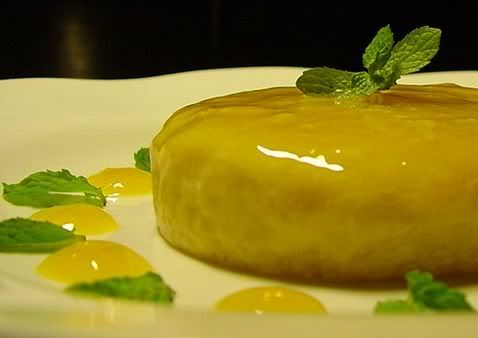
I was slightly more successful inside especially at night when I took the picture below. My mousse seems to be glistening with the coated honey mango sauce that I am now hungry for a fresh batch already.

Image hosted by Photobucket.com

Honey Mousse (from Sweet Temptations, Australian Womens Weekly)

40 grams butter
5 eggs, separated
135 grams white chocolate (I used Lindt)
60 ml honey (I used Manuka Honey)
2 teaspoons gelatine
2 tablespoons water
300ml thickened cream (I used Bulla's Pure Cream)

Coat 6 x 1 cup (250ml) ramekins with cooking oil spray. (I buttered them instead as I did not have any cooking oil spray). Combine butter, egg yolks, chocolate and honey in a medium pan, stir over heat without boiling until the chocolate melts. Transfer mixture to a large bowl. Meanwhile sprinkle gelatine over water in cup, stand in a small pan of simmering water, stir until the gelatine dissolves. Stir it into the chocolate mixture, cover bowl and cool to room temperature.

Fold whipped cream into chocolate mixture. Beat egg whites in medium bowl with electric mixer until soft peaks form, fold into chocolate mixture in two batches. Spoon mixture into prepared ramekins. Refrigerate for 3 hours or overnight. Turn mousses on plate to serve.

For the honey mango sauce: cut a mango and blend the mango flesh. Mix some honey in with the mango puree to taste. Add a touch of lime to prevent it from going brown.

Thursday, July 14, 2005

IMBB 16 - Eggs Round Up (Part 2 of 2)

Viv of Seattle Bon Vivant has posted the final part of the round up of all those IMBB 16 entries. Wonderful work of summarising those entries Viv! Those eggy dishes look so great that I can't wait to try them out in my kitchen.

Mangosteen Salad

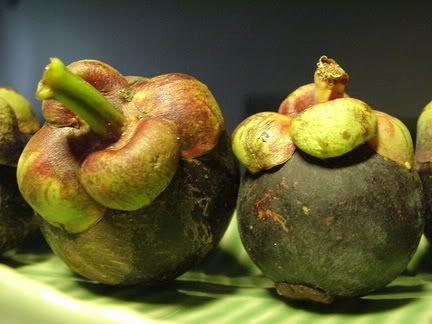
Last month, after I made the mangosteen sorbet, I have been kinda bitten by mangosteen fever. However as they are so expensive, I have been bugging Splashie Boy to get me some from his "kampung" (Malay for hometown village) as they're from his uncle's tree. So last week, he came back with a nice bag of mangosteens. They're quite small but I must admit, extremely sweet and less seeds since they're so tiny. Here's a picture of two of them I captured before I broke them up and made the salad.

Image hosted by Photobucket.com

As I said earlier on, I was keen to try out the recipe I found in
Flavours that featured the famous mangosteen salad from this vietnamese restaurant in KL called Sao Nam. I made some adjustments to the ingredients and also the layout of the salad after some experimentation. The recipe states dried cuttlefish strips but since I had some sotong (Malay for squid) bakar from Splashie Boy's Pangkor trip, I shredded those for the salad. In the magazine, the salad is assembled in a mound with prawns surrounding it, I tried doing that and failed miserably as it just looked so flat on my plate.

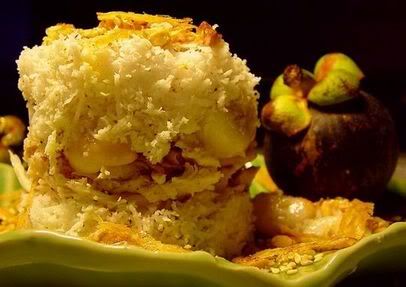
So instead, I whipped out a metal ring and started pressing the grated coconut and the other ingredients inside to make it into a tower. Not perfect looking but I thought it looked interesting. Because it had to be shaped as a tower, I used quite a bit of grated coconut, more than what the salad originally asked for but it was fine with both of us as we liked the grated coconut. If you're making it for yourself, adjust the ingredients according to what you like, i.e. add more coconut or mangosteen. You can see the middle layer where the mangosteen is peeking out.

The taste of the salad is light and refreshing. The flavours seem to come together with the sweet and slighty sourish calamansi lime dressing. Surprisingly, Splashie Boy who does not like mangosteens thought it was great. Too bad I did not have any crackers to go with it as I am sure that would have been even nicer.

Mangosteen Salad

Dressing
1 kg calamansi limes (extract juice only)
300 g caster sugar

100g freshly grated coconut
150g chicken breast, marinated with salt and pepper, grilled and sliced
100g dried cuttlefish strips, wok roasted
1kg mangosteen, peeled
200g medium sized prawns, cooked and peeled

Topping
50g peanuts, wok roasted and pounded
50g sesame seeds, wok roasted

To make the dressing, combine the lime juice and sugar. Stir till the sugar dissolves and chill until required.

Prepare salad by layering from the bottom in this order: grated coconut, chicken slices, dried squid, mangosteen, more coconut and prawns. (The prawn is on top of my tower) Top with peanuts and sesame seeds before pouring the dressing over. Serve with prawn or fish crackers.

Image hosted by Photobucket.com

Tuesday, July 12, 2005

Mushroom Steak

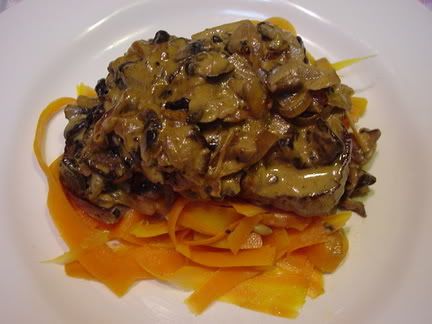
Sorry, no nifty title for this and I thought since it looks like a mountain of mushrooms on top of carrots, I better clarify that there is some steak underneath that mountain. You can see a bit of the steak peeking out from one end. Based on this picture, you can definitely tell that I love my fungi. I always have some kind of mushroom in my fridge or larder whether it's oyster, shitake, enoki, button, portobello, dried Chinese mushrooms, dried porcini and canned mushrooms. The mix below was some white button and fresh shitake mushrooms I had in my fridge.

You notice the carrots, they are shredded with my vegetable peeler to look like noodles. Extremely easy to make and fantastic for me as I am hopeless in cutting up things. I usually just boil them in some water and you can toss them in any sauce you like. Think of it as carrot noodles or pasta and pair it with whether sauce you like.

The mushroom sauce that goes with this steak is like a beef stroganoff except the beef steak is not sliced up. Recipe is from Jill Dupleix's Simple Food, I really like her style - simplest way to make things and very few ingredients. She has another cookbook that just incorporates three main ingredients called Take Three, that is super handy especially if you just cook occasionally and don't want to stock up your fridge and larder.

Steak with mushrooms (Serves 4)

1 onion, peeled
500g mushrooms
1 tbsp butter
1 tbsp olive oil
125 ml white wine or beef stock
sea salt and freshly ground black pepper
1 tsp sweet paprika
4 rump steaks around 200g each, abt 2.5 cm thick
3 tbsp sour cream or creme fraiche
1 tsp Dijon Mustard
1 tbsp tomato puree

Cut onion in half and slice thinly. Wipe mushrooms, discard stalk and slice finely. Melt butter and olive oil in a nonstick frying pan and gently cook your onion for 5 minutes. Add mushrooms and cook for 5 minutes. Add white wine or beef stock, sea salt, black pepper and paprika and bring to the boil, stirring. Reduce the heat and simmer for 5 minutes.

Heat another pan and brush steaks with olive oil and cook on one side for about two minutes. Turn and cook for another 2 to 3 minutes for medium rare. Season with salt and leave to rest in a warm place or covered with foil. Add sour cream or creme fraiche, mustard, tomatopuree and if you have some parsley, add it to the mushrooms and cook, stirring for 5 minutes. Place steaks on plate and spoon mushroom mixture on top.

Image hosted by Photobucket.com

Monday, July 11, 2005

Sizzy Sausies

Yippee yay, the rainy season seems to be back. Hopefully it keeps up as we do need rain to fill up those parched dams especially in Seremban which is facing water rationing. I honestly do not want any water rationing in KL so rain rain, please don't go away, stay as long as you like.

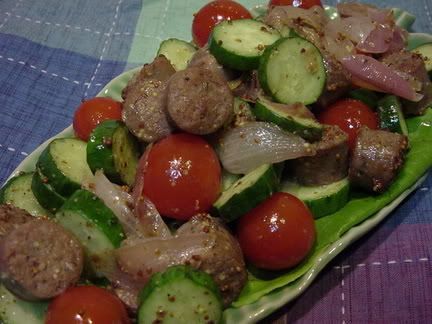
Salads seem to be happening everywhere, Lilian just blogged about some she made for her and her hubby and I am about to blog about our fave sausage salad. This winner is from one of my old BBC Good Food magazines and it's got healthy yummy fresh vegetables plus naughty meaty bits of sausages all coated in a tasty sauce made from wholegrain mustard and red wine vinegar.

As it's our main meal, we usually eat it stuffed in pitta bread or rolled up like a tortilla in those large Lebanese breads. It's also an express kind of recipe as it takes you a short while to chop, sizzle, serve and eat. Although the recipe called for avocados, the one we bought was not ripe yet so I had to omit it or else, it tastes extra nice.

Sizzling Sausage Salad

1 tbsp olive oil
400g good quality sausages
1 red onion, roughly chopped
1 heaped tbsp wholegrain mustard
1 tbsp light muscovado sugar (or light brown sugar)
16 cherry tomatoes
2 little gem lettuces (I used baby butterhead leaves)
1 large avocado
1/4 cucumber
1 tbsp red wine vinegar

Heat the oil in the pan and using the scissors, snip sausages into quarters straight into the pan. Throw in the onion and fry for a minute or two, Stir every now and then to brown everything. Spoon the mustard and sugar, tip in the tomatoes and mix them. Cook for a few minutes more until tomatoes are just above to split and everything is coated in the sweet mustard glaze.

Seperate the lettuce into leaves, peel and stone your avocado and slice up the cucumbers. Mix together and pile on plate. Spoon sausage mixture on top. Add vinegar and 1 tbsp water to pan and stir over the heat to dislodge those yummy bits from the pan. Add the pan juices on top of the salad and serve with your preferred bread.

Image hosted by Photobucket.com

Saturday, July 09, 2005

JoHoR SpEcIaLs

Recently, Splashie Boy and I went looking for food at Hartamas Shopping Centre, which had it's grand opening last month. The place is pretty quiet during the weekday and although it has quite a fair bit of restaurants, nothing took our fancy that night so we wandered out to the neighbouring Plaza Damas. Since we were new to the area in terms of eating (I had only been to the area to check out the numerous dance studios, kickboxing, yoga centers), we applied the universal rule of "if the crowd is there, the food must be good" theory.

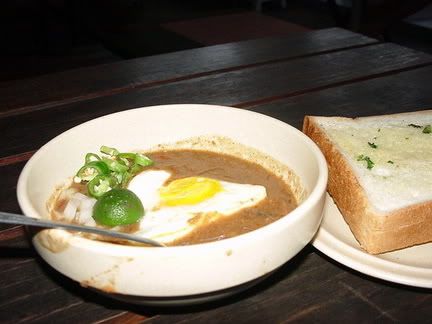
Hence, we wandered to this place called Warung Aji-Don Alley which was jam packed with people sitting outside on wooden benches. The place has a few stalls selling a variety of food that ranges from Johor Laksa, rojak, waffles, murtabak, mee rebus and etc. I was fascinated about this stall that sold something called Kachang Pol. The owner advised me that it was Malaysia's chili con carne so we ordered a bowl of it. It came with a thick slice of buttered toast, a fried egg on top with a sliced calamansi lime and loads of chopped green chillies for the added fire. The Kachang Pol was simply yum and Splashie Boy polished the whole bowl claiming it as his. A quick peek at my Foodsters' Guide from FriedChillies.com, indicate that the Kachang Pol is prepared by grinding the nuts (not sure what kind of nuts though). Then a mixture of spices like cuimin seeds, chopped onions, chopped garlic, curry powder, herbs and pepper are fried in a pan until fragrant. Then the grinded nuts are added to the mixture and finally the ground beef. Sounds easy but I bet there must be some secret ingredient in it to make it so yummy.

Image hosted by Photobucket.com

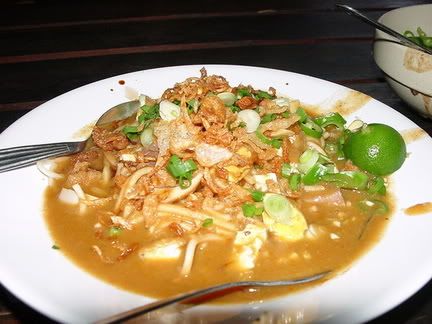
We also ordered Mee Rebus from the same stall. Not too bad as it was not too rich. Foodsters' Guide describes the gravy to be made from flour, peanuts, dash of vinegar and soya sauce. They also serve a special Mee Rebus during the weekends.

Image hosted by Photobucket.com

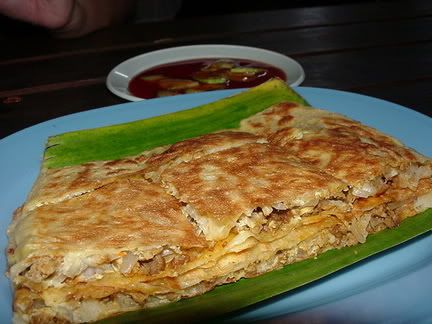
As the Kachang Pol was such a small portion, we added an order of Murtabak, a stuffed pancake that is famous in Malaysia. The stall owner calls his version a Moontarbuck and it tasted yummy, not too oily and crispy.

Image hosted by Photobucket.com

Foodsters' Guide describes a place called Tsya's at Block C at Plaza Damas for the Mee Rebus, Kachang Pol and murtabak. Had a quick look at Block C (the place is a bit of a maze) and there is no Tsya's there, only a mamak restaurant so I am not sure if that place closed down and the stalls came to this Warung Aji-Don Alley at Block E. Maybe someone can enlighten me on the little mystery. These Johor stalls remind me of this little shack at Desa Sri Hartamas which used to operate opposite Devi's Corner but had also closed down. The place was also packed with stalls selling Johor food as we met Ms. P's parents there once telling us the murtabak is how the Johoreans do it. Maybe those stalls migrated to this place since the murtabak tastes quite similar. Well, whatever their origins are, I will definitely make another trip here to eat the Kachang Pol and probably test out the Johor Laksa and other stuff here.

Warung Aji-Don Alley
E-O-16, Block E
Plaza Damas
60, Jalan Sri Hartamas 1,
Sri Hartamas
50480 Kuala Lumpur

(Stalls operate mainly at night although some are opened during the daytime)

*Disclaimer: The opinions expressed here is entirely based on my personal tastebuds and may vary for others. The reviewer also declares that she has not received any monetary or non-monetary compensation from the restaurant for writing this review.


IMBB 16 - Eggs RoUnD Up (PaRt OnE)

Thanks to Viv from Seattle Bon Vivant, she has had the uphill task of summarising the numerous entries for the IMBB round-up on her blog. Wow, can't believe that there were 81 entries this time. Glad to be a teeny weeny part of that egg-xciting group.

HaVe a CuP of TeA

I was so massively depressed yesterday after reading all those accounts of the London bombing that I honestly had no mood to blog about food. After hearing about the bomb blasts, immediately tried to contact Ms. P to check on Ms. C who lives and works in London. Heard from Mr. D, Ms. P's other half that she is A-okay. Not sure about Ms. D since she is quite slow in replying her emails but I am sure she must be busy helping out with the victims if her hospital is involved. Hope the rest of the people I know who live in London or around it is also okay. Incidentally, while watching the BBC coverage on the bomb attacks, saw one ex-university mate as he is now a BBC reporter reporting at the scene.

After reading the accounts of the people who were in London and also Cheat Eat's posting on boiling the kettle, I guess it is true that in the face of anything bad, the Brits will always put the kettle to boil for a cuppa. Believe me, it works as I had done that gazillion times when I was studying there, you just sit down with a hot cup of tea in your hands, pour out your troubles to your friend and everything seems a bit more bearable. Life goes on and the Brits has shown to the world that this act of terrorism will not change their way of life so I am following their great example and this blog goes on.

Thursday, July 07, 2005

BaCkOfEn

This is one of the longest surviving bakery cum cafe in town which we love and have remained faithful throughout the years. Incidentally, Backofen means baking oven in German. Originally from Bangsar, they are now located in Desa Sri Hartamas and is an excellent place to grab a quick and quiet dinner during the week. We love the food here as it's unpretentious and the quality has not changed a bit even though the original Austrian owners have sold out their business to a local. I have an ex-colleague, Mr. J who loves this place also and we often see him here with his latest squeeze. Not sure whether he is still in town or gone back to New Zealand as we haven't seen him here for quite a while.

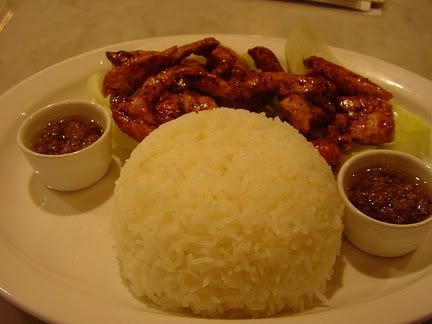
The place serves Austrian delicacies and local dishes. Splashie Boy and I have so many favourites and sometimes it's difficult to choose what we want. I usually have the teriyaki chicken with lashings of garlic sauce.

Image hosted by Photobucket.com

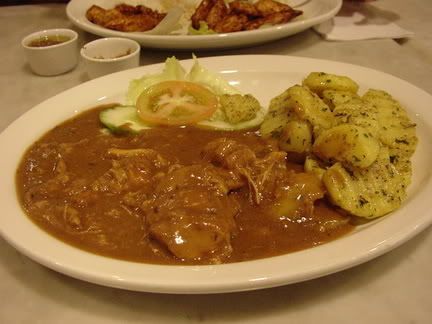
This is one of their specials, Rosmarin Chicken with Potatoes; the chicken is a special dish made from Rosie, the ex-owner's recipe.

Image hosted by Photobucket.com

Other dishes we love are the Chicken Stroganoff, Hungarian Goulash, Spaghetti Carbonara, Bratwurst and the Potatoes with Fried Eggs.

Backofen
34, Jalan 24/70A
Desa Sri Hartamas
50490 Kuala Lumpur

*Disclaimer: The opinions expressed here is entirely based on my personal tastebuds and may vary for others. The reviewer also declares that she has not received any monetary or non-monetary compensation from the restaurant for writing this review.

StEaMy ChIcKy

Gosh, not sure what is wrong with this month since I have had such a string of bad luck especially with my computer. Last week, the modem went bust so I had to go round to Clickers to get it replaced. Considering it has served me for almost three years, I guess it was time for it to expire to computer heaven. Once the dust settled with the installation of my new modem by Splashie Boy, I was super happy as it felt faster and better. Then before I knew what happened, my internet connectivity died on me. I tried everything; change cable, use the USB port rather than connecting direct and tested my new modem with other computers but nope, nothing worked. So I reported the matter to Streamyx and luckily they fixed it quickly so I am back on line today. Hopefully that is the end of my bad luck for this month as I don't think I would like to get out of bed if that is just the tip of the iceberg.

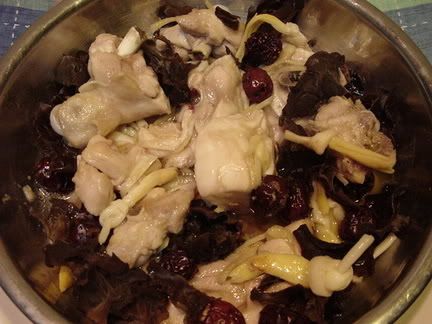
Okay, so back to posting entries as they seem to be piling up in a stack in my virtual inbox. After making Loh Hon Chai that day, I had lots of leftover black fungus and dried lily bulbs in my fridge so I thought I'll make another dish from my childhood days. My mother had a variety of steamed dishes that she used to make for us and this was one of them, steamed chicken with black fungus, dried lily bulbs and red dates.

Using the same principles of the Loh Hon Chai, all you need to do is assemble your dried ingredients of the black fungus, red dates and dried lily bulbs and soak them for a few hours. Remove the hard bits and tie up the lily bulbs in a knot. According to my mother, it tastes nicer if you knot them. For the chicken, all I did was remove the skin from one chicken leg and cut them in smaller pieces. Toss it in a mixture of oyster sauce, dash of soya sauce and shaoxing wine with some cornstarch. Cornstarch is important as it helps prevent excess liquid in your steamed dish. Shred some young ginger and pile them on top and steam for about eight to ten minutes over medium heat.

Image hosted by Photobucket.com

Monday, July 04, 2005

BaSkEtBaLL FooD

We had "makan" (Malay for eat) session last weekend with my family so it was Chinese food at Pik Wah, near Petaling Street, one of our regular places. We call it the basketball place as the restaurant is located within the Malaysian Association of Basketball's Sports Complex.

As my aunt is quite fussy about her food, we have some restaurants that are designated okay for her taste requirements. When I was young, my aunt was even fussier as she would only eat at the Chinese restaurant in Equatorial Hotel as they knew the head chef there. Those were the good old days as the food was super yummy - they used to serve the best Yee Sang, just the right mix of sauce and ingredients. However, since the head chef has retired, food quality has dropped tremendously and even though they still serve their signature dishes, it is not the same. After losing our regular place, one of the places we started going to was Pik Wah. I am not sure why exactly but I think there was some link to the Equatorial place, something to do with the ex-staff joining here.

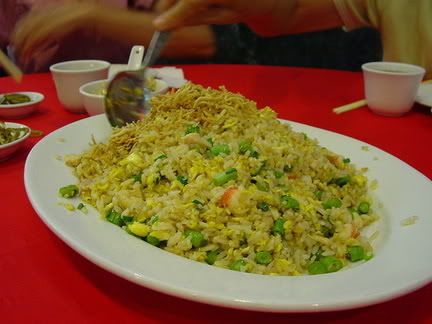
Whenever we visit Pik Wah, we have a fixed list of must-haves that we order as we love the way they cook those dishes. One of the essential orders is their fried rice. Fried with bits of long beans, chicken, prawns and eggs, sprinkled with crispy ikan bilis (Malay for anchovies), it is one of the yummiest fried rice around town.

Image hosted by Photobucket.com

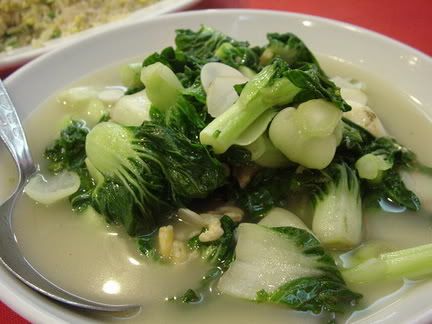
I am not very sure what vegetable this is - I think small pak choy? This comes with a soup made from a base of dried small prawns. There are many versions of this soup, the one I usually make is from ikan bilis or you can even make it with dried small prawns and yam.

Image hosted by Photobucket.com

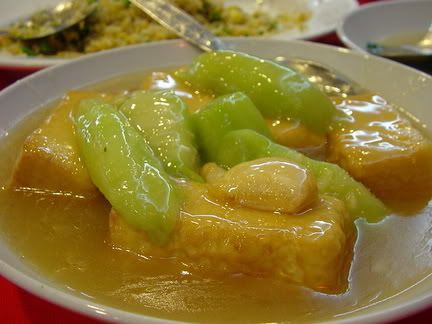
Here is the braised tofu and sweet gourd dish that is quite standard in most Chinese restaurants. The tofu is usually home made by the restaurant.

Image hosted by Photobucket.com

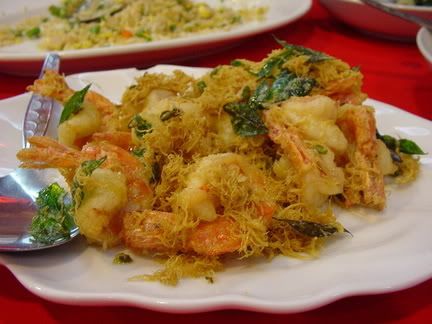
Splashie Boy's favourite dish, the butter prawns. At his request, they shelled the prawns for him as he is allergic to peeling prawns! For those who are unfamiliar to this dish, the strands are actually margarine fried with evaporated milk and the green bits are the curry leaves.

Image hosted by Photobucket.com

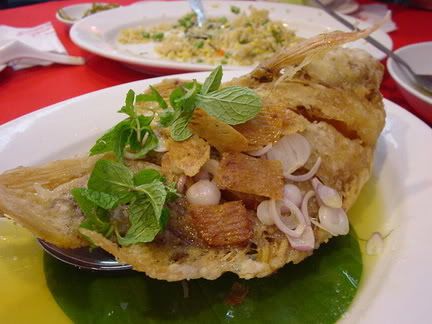
This is one of Pik Wah's signature dishes, the Pattaya style fish. We usually order red talapia (fei chou yee in Cantonese). As the fish is reared in ponds, sometimes you can get those that still smell of the silt in the pond. To avoid this, restaurants usually keep the fish in their tanks for a few days. The sauce is super yummy, we reckon it's made from calamansi limes and some sugar. They sprinkle raw shallots, dried cuttefish and mint leaves on top of the fish.

Image hosted by Photobucket.com

Restoran Pik Wah
MABA House
Basement Level Stadium Block
6 Jalan Hang Jebat

Tel No: 03 - 2072 3668
*Disclaimer: The opinions expressed here is entirely based on my personal tastebuds and may vary for others. The reviewer also declares that she has not received any monetary or non-monetary compensation from the restaurant for writing this review.

Saturday, July 02, 2005

SiNfuL SaTuRdAy

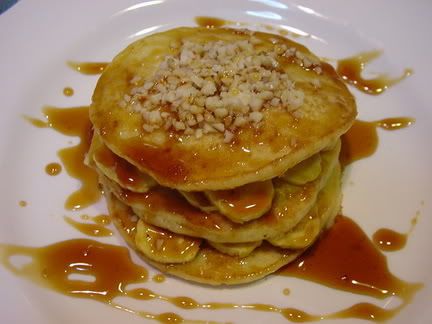
Sorry for the sporadic postings, had to wait for a while to download my pictures from the camera. The good thing is I have loads of pictures to put up day by day. We kickstarted this weekend with sinful calories all loaded up in these yummy Coconut Pancakes with Gula Melaka (Malay for palm sugar) syrup.

Recently I got hold of the June edition of delicious - the Australian version and they did a feature on pancakes and waffles and this recipe caught my eye since it had the Asian element. We had eaten pancakes with Gula Melaka syrup before at Elly's Table, Centrepoint and they do work well together. Although the recipe is for three to four portions, we finished them up as the pancakes are quite light. With the syrup, I only made half portion and there were still some leftover syrup.

Since I did not have any vanilla beans, I replaced that with some vanilla essence. If you have any pandan leaves, you can probably add that when you cook the syrup for additional flavour. After cooling the syrup (I made it one day ahead), the syrup will thicken slightly. The coconut pancakes are light and fluffy with the egg whites folded in. You taste the slight coconut flavour with the dessicated coconut.

Coconut Pancakes with Gula Melaka Syrup

500g dark Gula Melaka (Palm sugar), grated
1 vanilla bean, split, seeds scraped
150g plain flour
1 tsp baking powder
1 tbsp caster sugar
40g dessicated coconut
2 eggs, seperated
125 ml milk
125 ml coconut milk
25g unsalted butter, melted plus extra to brush pan
3-4 bananas, sliced lengthways

To make syrup, place palm sugar in a pan with vanilla pod and seeds and 2 cups of water. Bring to the boil, then reduce heat and simmer for 15 minutes without stirring, until reduced by half. Strain and then cool, then refrigerate until needed.

Sift dry ingredients into a bowl and add the dessicated coconut. Beat together the egg yolks, milk, coconut milk and melted butter in a seperate bowl, then whisk into the dry ingredients. In a clean bowl, beat the eggwhites with a pinch of salt until soft peaks form. Use a metal spoon and carefully fold it into the batter.

Heat non-stick frying pan over a medium heat and brush with some melted butter. Drop tablespoons of the mixture into the pan two to three cm apart and cook for 1-2 minutes until golden. (For me, if there are bubbles on the surface of the pancake, I will turn them over and cook them for another minute) Transfer to a baking tray covered with foil and keep warm in a low oven until you finish making your pancakes. Serve 2-3 pancakes in a stack with sliced bananas in between. Drizzle the syrup over and enjoy!


Image hosted by Photobucket.com

Thursday, June 30, 2005

TeaTiMe ApAm

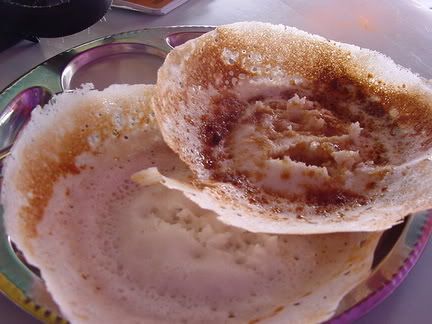
Recently after a doctor's appointment in Bangsar, I was feeling peckish so I tried these roadside stalls that sell these yummy-licious apam. Been a while since I ate there, the last time was when they used to be the stalls in front of Strudels, Lucky Garden. Now they have all moved to the other side of Lucky Garden, near the fruit stalls and in front of the veterinary clinic.

They sell two varieties; one with white sugar and the other with brown sugar. Done slowly over the fire in small woks, these apams are so nice and crispy (much nicer than my usual brekkie place). The apam is actually made from a batter of rice flour, coconut milk and sugar and they give you sweetened coconut milk for you to dip the apam in.

Image hosted by Photobucket.com

Om Shakti Chelo's Apam Stall
Lorong Ara Kiri 3, Lucky Garden, Bangsar

They're opened at teatime onwards (not sure what time it closes) but they are closed on Sundays.

*Disclaimer: The opinions expressed here is entirely based on my personal tastebuds and may vary for others. The reviewer also declares that she has not received any monetary or non-monetary compensation from the restaurant for writing this review.

CoMfoRt Me WiTh PiE

Although the weather is hot, I had the urge to make Shepherd's Pie as it is really one of my favourite comfort foods. I have been in the mood for some comforting so I can't deny fluffy mash and yummy minced lamb filling. This is a version of Nigella Lawson's famous Rudolph Pie - she does it with minced venison and a cherry on top ala Rudolph for Christmas.

Splashie Boy loves English food - must be something they injected into his bloodstream when he was born in Reading. I used to joke that his mother picked up the wrong baby in hospital since he is so non-Malaysian in his eating habits but like someone pointed to me, that can't be possible since he would have been the only Asian baby in the ward. For me, English food has some bad and good memories depending on well my dining hall used to cook it. Fond memories are for the pies like Shepherd's, Beef and Guinness but not for their super bouncy and hard Lemon Meringue Pie. Other things they excelled in was steamed puddings (yum!) with lots of custard. Then there is Rhubarb Crumble which I love and so rarely get it here.

Okay, back to my pie - mine is full of minced lamb as it is not easy to come across minced venison in KL and without the cherry on top. Nigella's version uses deluxe stuff like dried porcini mushrooms and chopped up button mushrooms that tastes extra nice. If you have time, leave the pie for a few days frozen in your freezer as when you bake it in the oven, it tastes nicer as the flavours have really developed. If you are making it, do look at the proportions as Nigella's version is for a huge batch. This recipe is from her Christmas Bites telly show and is also found in Feast.

Rudolph Pie (Serves 14-16)

50g dried porcini
3 - 5 tablespoons olive oil
4 onions chopped
4 carrots chopped
4 cloves of garlic peeled and minced
500g button mushrooms, quartered
1kg minced venison
1kg minced pork
2 tablespoons flour
6 tablespoons Marsala
2 tins chopped tomatoes
2 tablespoons tomato puree diluted in 125ml water
Worcestershire sauce to taste

Topping:
4kg potatoes
1500g parsnips (about 8 medium-sized)
125ml full-fat milk
125g butter, plus more to dot on the top
nutmeg
sprinkle of Worcestershire sauce

Pour 500ml of near-boiling water over the porcini mushrooms and leave to steep.Warm oil into very large thick bottomed pan and add the chopped onions, carrots and minced garlic. Cook stirring for about 10 minutes, sprinkling with the salt if the vegetables look as if they may burn. Drain the porcini, reserving the soaking liquid, chop coarsely and add with the button mushrooms to the vegetable mixture. After about 5 minutes tip the whole lot out to brown the meat.Add a little more oil to the pan then tip in the minced meats, breaking them up with a wooden spoon. Stir for about five minutes until the rawness has left them a bit, add salt - unstintingly - and then return the vegetable mixture to the pan. Stir in the flour and add the mushroom-soaking liquid, tinned tomatoes, diluted puree, Marsala and a few drops of Worcestershire sauce.Stir well, cover partly with a lid and reduce heat so that the mince bubbles gently, for about 40 minutes to an hour.

Meanwhile boil the potatoes in a large pan of salted water until they are nearly ready and then add the parsnips which have been peeled and cut into chunks.Boil until they are cooked to easily mashable tenderness, then drain and allow to dry slightly.Warm the milk and melt the butter in the heat of the potato-pan. Rice or mash the potatoes and parsnips straight into this, grate in some fresh nutmeg and add salt to taste.Put the mince into a large dish approximately 37cm x 32cm, then dollop the potato mash on top, spreading with a spatula, taking care to seal the edges to prevent the meat below from bubbling up in the oven.Fork lines over the top, then dot with butter and sprinkle with Worcestershire sauce.If you're cooking this straight away, about 10 minutes in a 225C oven should be enough to make it piping hot and crispily golden on top. If cooking from cold, about an hour in a 190C/Gas 5 oven should do it.
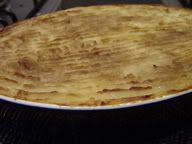
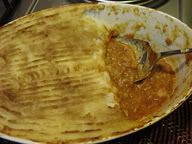
Image hosted by Photobucket.comImage hosted by Photobucket.com
Left: Straight from the oven, Right: All revealed with its yummy insides
MEME - ThE CooK NeXt DooR

I had been earlier tagged by Lilian of Penang Faces to answer my first Meme and boy, aren't these questions tough hence I procrastinated on answering them!

What is your first memory of baking/cooking on your own?

I was a late starter in cooking and I only got started as I did not want to die from hunger. My first memory of cooking is making cheese sauce for my pasta in my first year in university. I was taught how to make it from a roux by sweet Caroline of Botswana so I would not starve to death.

Who had the most influence on your cooking?

I credit both my parents; my mother, the cook and my dad, the foodie. When I was young I remember my mother going for baking and cooking classes to learn new things all the time. She is a real legend in baking and people always demand her ever light and fluffy chiffon cake. She is a real perfectionist as I still remember how she practised so hard to get it right and since then she has always made a perfect chiffon cake. With my dad, he would always sniff out good food wherever he went in the world. He dragged me to so many markets and dingy stalls just to sample great food.

Do you have an old photo as “evidence” of an early exposure to the culinary world and would you like to share it?

Sorry no photos of me cooking as I don't think anyone has taken one of me before in the act!
Mageiricophobia - do you suffer from any cooking phobia, a dish that makes your palms sweat?

Splashie Boy's mother's signature nasi lemak. He credits his mother's nasi lemak as the best in town so I doubt I will ever be able to make the sambal the way he likes it.

What would be your most valued or used kitchen gadgets and/or what was the biggest let down?

Okay, I know it ain't a kitchen gadget but I love my wok and really can't think of life without it. It's so multi versatile as I use it for stir frying, deep frying and steaming since I don't have a special steamer. My biggest let down are those hand held graters. I can't seem to get one that gives me nice fluffy grated parmesan cheese like Jamie Oliver!

Name some funny or weird food combinations/dishes you really like - and probably no one else!

Okay, I have a sweet tooth and I find funny things to sprinkle sugar on; my toast which got me a lot of stares in England during breakfast and even my chinese dumplings. My Mauritian friend is worst than me, she used to dump six packets of sugar in her coffee and her excuse is she is helping Mauritius' economy since they produce sugar!

Another thing I like to eat is kerabu chicken leg skins! Strange stuff as it's gelatinous, crunchy and all spiced up with the thai herbs.

What are the three eatables or dishes you simply don’t want to live without?

I love my vegetables and I really can't do without my tomatoes, mushrooms in all varieties and pumpkin.

Any question you missed in this meme, that you would have loved to answer?

Not that I can think of.

Three quickies:

Your favorite ice-cream… : Ben & Jerry's Chocolate Chip Cookie Dough (yummy chunks of choc chip dough treasures that I dig out to enjoy)

You will probably never eat… : Dogs, cats, snakes, monkeys and any other animal that I consider to be a pet. I once refused to eat a chicken as I played with it once and my mother was so annoyed with me.

Your own signature dish… : No idea which one am I famous for as I cook anything I can get my hands on.

Who do you want most to cook you dinner? : Splashie Boy as he so rarely cooks for me. Once he did rustle up some El Paso tacos for my Valentine's dinner.

Three people to tag:

Okay, this part really stumped me for the longest time as honestly I don't know many foodie bloggers as I am totally new to this. Morevover the ones I know or have been leaving comments in their blogs have already been tagged. Anyway, I came up with my friends as I am sure they do cook even though they deny it:

Jess from Two J's - She does do some cooking besides looking after her two cutie pies.
Drew from Tiny Thinks and Tiny Thoughts - I know you do cook as you keep talking about trying my recipes. Time to share what you're cooking up in Singapore. Gross stories about your fetish for boiled luncheon meat, porridge and your famous air sick bag story are acceptable.

Shagen and Vera from New Zealand at last - Not sure about Shagen but Vera definitely cooks as I have tasted her food before in KL. Time to spill to us how cooking in New Zealand is different from Malaysia.

Tuesday, June 28, 2005

ThE WeLL TrAvElleD PiCkLe

I was thinking of a nifty title for my auntie's pickles (or what we call Acar in Malaysia) and thought hey, how about boasting a bit on how well this acar has travelled. My aunt (the one who made the chinese dumplings earlier) is a super duper cook and lucky for us she is always piling us with delicious food. She made this really yummy acar last week and all I got was a teeny weeny jar which I am now treasuring.

My aunt has certain signature dishes to her fame and one of them is this acar. The other one was her sambal hai bee (prawn sambal) which I used to carry faithfully each year to England and ration them since it was for my whole year there. I was told by my mother that this is not the usual acar that people have. I guess they don't come with the peanuts and it's just plain with vinegar. Am I right? I honestly don't know as the only acar I eat is my aunt's one. Her version has cabbage, cucumbers and carrots - all coated in chili sauce and crunchy peanuts. This tastes wickedly nice and goes well just on it's own i.e eaten sinfully from the jar, with some prawn crackers or with white rice. It's well travelled as it's gone to Australia, Canada, England, Hong Kong and Singapore.


Image hosted by Photobucket.com

Sunday, June 26, 2005

MaNgOsTeeN SoRbEt

The weather is super hot in Malaysia recently as we have not seen a drop of rain these past few days. As usual, when the heat strikes, I am always thinking of ways to cool off and I thought of making another sorbet. I was inspired by the mangosteen which is in season this month and has started flooding the fruit stalls in Kuala Lumpur. However, I notice that this year, the ones available are super tiny. Not sure why but my uncle offered a theory to say that nowadays the local farmers are cultivating nice fat and juicy ones for the export market like Japan as they earn more profits. The other downer about buying mangosteens are they are not a cheap fruit. You will think it's cheap since it is local but nope, it is selling for about RM4.99 per kilogram in Kuala Lumpur.

I bought a few mangosteen to make this sorbet that I saw in Vogue Entertaining's Short Order and Seasonal Cookbook (Autumn/Winter) since it looked so lusciously cooling and inviting. Not a cheap venture as once you deseed mangosteens, you don't get much pulp left. However, once you mix your sorbet up and when it is ready to scoop, it is so nice and cooling plus it is a great light purplish pink colour. As I don't have an ice-cream maker (am still contemplating whether to get one from my Citibank Reward Points), I just agak-agak (Malay for estimate) and throw everything in the blender to whiz to smoothen it out. Although the original recipe stated limes, I used the small calamansi limes that give a more orangish juice. Originally I thought of replacing the liquid glucose in the recipe with a sugar syrup but I managed to find some in a bake shop.

I guess the next time round if I can get my hands on some nice mangosteen and cheaper ones, I will try to make the mangosteen and prawn salad from Sao Nam Restaurant that serves yummy South Vietnamese cuisine.

Mangosteen Sorbet

500g mangosteen flesh, deseeded and shells reserved for decoration
juice of 1 lime (or to taste) - I used calamansi limes
100g caster sugar (or to taste)
100ml liquid glucose
8-10 mangosteen shells with lids, rinsed and dried

In a blender, puree the mangosteen flesh with the lime juice and the sugar till smooth. In a small saucepan over low heat, melt the glucose and pour it into the blender with the mangosteen mixture. Blend together. Taste the mixture and if it is not sweet, add extra sugar and if too sweet, add more lime juice. If you have an ice-cream maker, process it as per the equipment's instructions or if you don't have one, just put it in a plastic container to the freezer and blend it again about 4 hours later. Leave it in the container till the next day and then scoop out into the mangosteen shells to serve.

Updated (21/7/05) : Recently came across a recipe for the sorbet and the chef served it with blueberry compote. Sounds like an interesting combination to try.

Image hosted by Photobucket.com

Saturday, June 25, 2005

IMBB 16 - Eggs

This month's IMBB 16 is hosted by Viv of Seattle Bon Vivant who hails from the rainy city of Seattle and she has chosen the theme of eggs. Such a humble ingredient but so many ways to make things out of it that I cracked my head thinking up an appropriate entry (see my earlier posting for what else I cracked up). I wanted something Malaysian and since we are a multi-culture society, it had to be something Malay. Moreover, I have yet to blog on any Malay food and I notice there is a lack of focus on this type of cuisine.

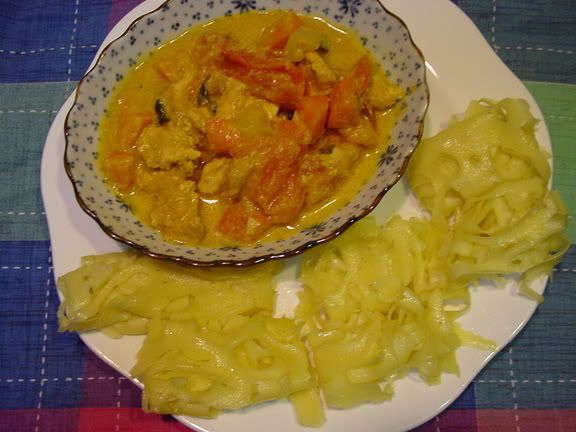
So I flicked through my library of cookbooks and magazines and noticed that eggs don't really feature a lot in Malay cuisine. It's either used as a garnish or cooked in a curry we call sambal in Malaysia. The other recipe I stumbled upon was eggs cooked in coconut milk which I thought I won't eat that as it sounded too rich! Sambal telur was toyed around but then I thought, it ain't much of a challenge. So I decided to try something mammoth called Roti Jala, a Malaysian pancake which means lacy/net egg pancakes which we eat with curry chicken and potatoes.

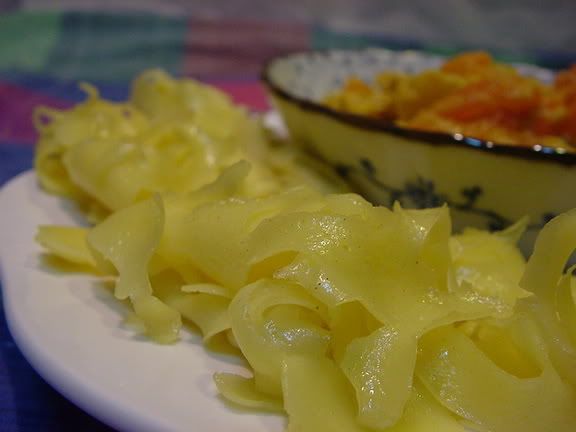
When I say mammoth, I thought I could tackle the task but I must admit, it is not easy to come up with perfect lacy pancakes and I kinda failed in making mine. My lace was not fine enough so it did not turn out to be the ideal Roti Jala. Oh well, I did enjoy making them, will definitely learn from my mistakes and despite their appearance, they tasted really nice.

My version of Roti Jala and the accompanying curry is all from a favourite local magazine of mine called Flavours. Published by a local newspaper, the Star, the monthly magazine features local food, restaurant reviews, wine reviews and etc. This recipe for Roti Jala is by Rohani Jelani, a popular chef who conducts cooking classes and workshops. It is a low fat version as the usual coconut milk is replaced with low fat milk. Even the curry that accompanies it is low fat as it is made from chicken breasts, low fat yoghurt and low fat milk.

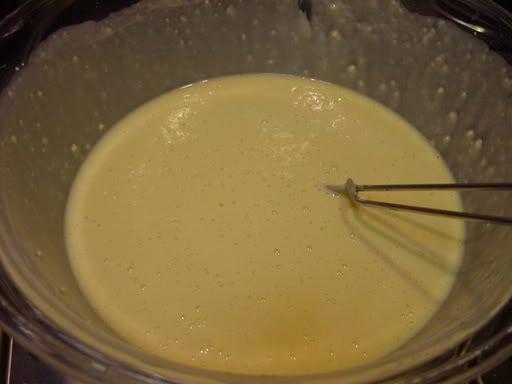
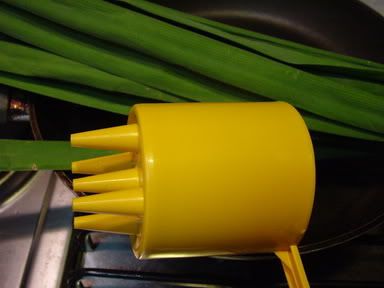
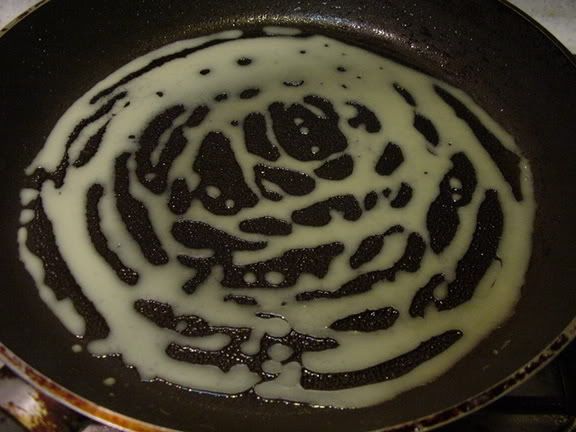
To make Roti Jala, you need a mould that is found in most supermarkets (See the yellow mould below). If you can't get the mould, you can make one from poking holes in a can but make sure your holes are of equal size so the liquid flows down in equal proportions. I used a bit of turmeric in the batter so the pancakes has a nice light yellow colour. The batter is also sifted to remove lumps. As I did not have a flat griddle or a crepe pan, I used an ordinary frying pan which made it difficult to remove the pancake. As I was having problems removing it, I folded the pancake the same time so my pancakes don't look neat. You can also use a bunch of pandan leaves to brush the oil on the pan. It adds a lovely and slight flavour to your pancake.

Image hosted by Photobucket.comImage hosted by Photobucket.com
Top Left: Sifted batter, Top Right: Mould and pandan leaf brush
Bottom Left: Pancake being cooked, Bottom Right: Roti Jala and curry

Roti Jala (makes about 30 pancakes)
300g plain flour
1 level teaspoon salt
1/4 teaspoon turmeric
300 ml low fat milk
3 large eggs
300 ml water
2 tablespoons vegetable oil
A little oil for greasing the pan

Sift flour, salt and turmeric into a mixing bowl. Make a well in the centre and into this, pour the milk, eggs, half the water and the oil. Use a wooden spoon or a whisk to incorporate the flour into the liquid to make a smooth, thick batter.

Stir in the remaining water and strain the batter through a fine sieve. This helps remove any lumps that will plug your roti jala mould that will cause problems. Cover the bowl with a clean cloth and set the batter aside for 25-30 minutes.

Heat a heavy griddle pan or non stick pan over medium heat and brush surface lightly with oil using your pandan brush. Stir batter, dip in the roti jala mould into it and fill it about 1/3 full and move around the pan in steady concentric circles to form fine lacey pancakes.

Image hosted by Photobucket.com

I suspect I failed in making my pancakes lacy enough as I overfilled my mould with batter so it came out thick and I was too far away from my pan. I should be nearer i.e. about 6 cm away from the pan when rotating the mould.

Despite my failed attempt to make real lacy Roti Jala, I enjoyed myself as it was the first time I was making a Malay dish. I guess I just need to practice more often and thanks to Viv, I got a chance to try my hand in making them.

My MaLaYsIaN EggS-pErIeNcE

I was racking my head on what to cook for this month's IMBB since there are so many ways to present eggs that I sought divine inspiration by flicking through some cookbooks. I found this very informative book called Encyclopedia of Asian Food - The Definitive Guide to Asian Cooking by Charmaine Solomon. I love the way she explained things especially the way she categorised her egg dishes so I borrowed her indexing to give you an insight on my take on eggs in Malaysia. It may not be comprehensive and feel free to advise on any other eggy dishes that should be added.
Background

Eggs are easily available and reasonably priced in Malaysia thus making it an important source of nutrients. Usually eggs are supplied en masse by poultry farms but occasionally you will get small stall owners selling eggs fresh from the kampung (Malay for village) or their own backyard. Nowadays not that many people rear chickens in the urban city as they feel it's too dirty or troublesome to keep chickens at home. When I was a kid, I remember we had a pair of small white chickens (not sure what their breed was) and they used to lay a teeny weeny egg for my breakfast.

Nowadays there are so many kinds of eggs to choose from; organic ones, special ones with no cholestrol, Omega 3 eggs and etc. They also come in different sizes; small, medium and large. Small eggs are ideal to half boil and the yolk is larger than a normal egg. Medium eggs are generally used for baking and cooking. Large eggs have more egg white, extremely ideal to make chiffon cakes and sometimes there could be double yolks inside.

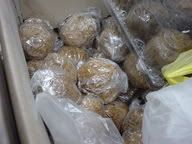
Duck eggs are used to make salted eggs and century eggs. Salted eggs are a popular condiment for porridge. In China where these eggs originated, the Chinese discovered that to preserve the egg, they can soak it in brine for more than a month. Once soaked, it is encased in salted mud and straw. By soaking the egg in brine, the egg white gets more firmer while the yolk gets denser as water in the egg is drawn out with osmosis. As there will still be bacteria within, it is advisable to cook the salted eggs either by hard boiling them or cooking them with their ingredients. Nowadays, restaurants use the raw salted egg yolk to fry crab or prawns as the sweetness of the seafood complements the salty and creamy taste of the salted egg yolk perfectly.

Century eggs or thousand year eggs are coated in salt, wood ash and lime mixed to a paste with water. It is an acquired taste for these eggs as the eggs are black in colour while the yolk turns greenish goo. Some also avoid it as they can't stand the smell and they claim that it is actually cured in a mixture of horse urine and mud. Usually, the eggs are used in porridge or just eaten plain with ginger pickles. It is also used to make the three egg steamed egg custard dish together with salted eggs and hen's eggs that Chinese homes love to serve.

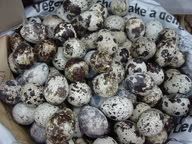
Quail eggs are sought after as a delicacy by some but has dropped in popularity with Malaysians as they are deemed to be extremely high cholestrol for adults. They are usually used as part of dessert with some sweet syrup. You can also add quail eggs to curries.

Image hosted by Photobucket.comImage hosted by Photobucket.com
Top Left: Fresh eggs, Top Right: Salted duck eggs
Bottom Left: Century eggs, Bottom Right: Quail Eggs

Scrambled Eggs

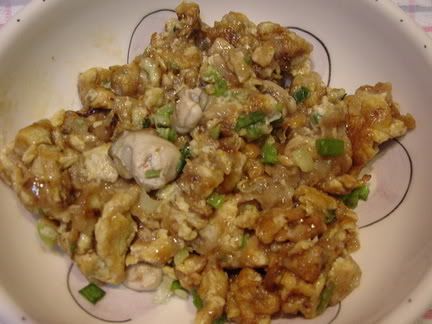
Scrambled eggs does not really feature that big in Malaysian cuisine so it took me a while to look for a picture of one. I found one in this hawker's version of Oh Chien (Chinese for Oyster Omelette). Although it should come in a form of an omelette with the Oh (Chinese for oyster) on top, some hawkers in Malaysia have different intepretation of it. So far besides this scrambled version, I have seen some which have cooked the oysters in the omelette until it's crispy and one which made it thicker and like a frittata.
For the Chinese, plain scrambled eggs is so boring that usually they throw in other delicacies like shark fins, crabmeat and water chesnuts in their version called kwai fah chee that is served in restaurants.

Nasi Lemak, what Malaysians may call their national dish that comes with rice cooked in coconut milk served with sambal, slices of cucumber, fried peanuts, fried ikan bilis (Malay for anchovies) and egg. Usually the egg is either hard boiled or fried but there is one stall owner in Bangsar, Nasi Lemak Lee that serves up his version with scrambled eggs.

Image hosted by Photobucket.com
Oh Chien - all scrambled out

Omelettes

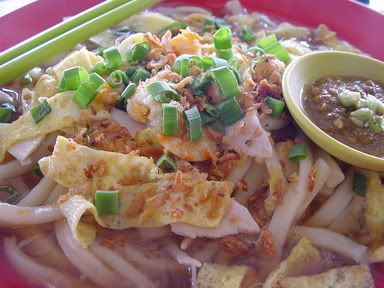
Omelette is also not featured in a big way in Malaysia and is usually added on as a topping or a garnish to an exisiting dish like fried rice or fried noodles. In this version of Lam Mee, strips of omelette are added on to the noodles as decoration and additional ingredients. Lam Mee is also known as Birthday Noodles and is served for birthday occasions especially in Penang.

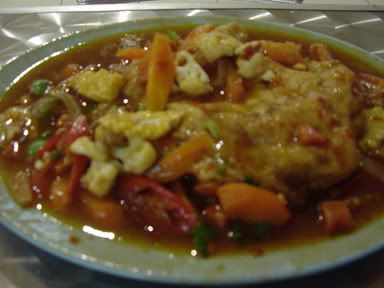
For my second omelette dish, I had to turn to Thai hawkers. As Thailand is our neighbour, Thai food has kinda creeped into our system and has become a permanent feature in hawker centres and mamak stalls. This popular version is called Telur Bistik, where they cook the omelette in a sweet and sour sauce with vegetables. Ideal as a quick meal for lunch or dinner with lots of piping white rice to soak up all that tangy sauce.

Image hosted by Photobucket.comImage hosted by Photobucket.com
Left: Lam Mee, Right: Telur Bistik

Boiled Eggs

Hard boiled eggs is used extensively in Malaysia and you can see them everywhere as garnishes and toppings for rice and noodle dishes like Nasi Lemak, Mee Siam, Laksa and etc.

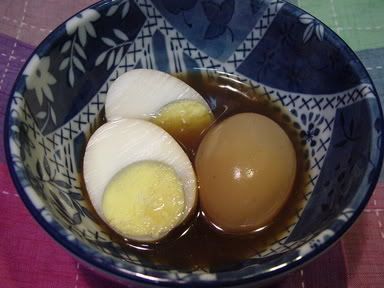
One popular way Teochews cook their eggs is with soya sauce and they call it Tau Yu Tan (Chinese for Soya Sauce Eggs). These eggs are brown in colour after being stewed in the sauce and is ideal for eating with white porridge.

Image hosted by Photobucket.com
Tau Yu (Soya Sauce) Egg

For the Malays, hard boiled eggs can be used to make Sambal Telur, where hard boiled eggs are cooked and then deep fried. Then a hot and spicy sauce is prepared from lots of chillies which is added with the hard boiled eggs. The Indians also deep fry their hard boiled eggs and add it in their rojak together with other fried stuff, some sotong and shredded cucumber and carrots. Then a hot and spicy peanut sauce is poured on top. As the rojak is extremely spicy, the rojak man always sells it together with a cendol man which is a cold dessert that helps bring down the heat of the rojak.

Image hosted by Photobucket.comImage hosted by Photobucket.com
Left: Sambal Telur, Right: Indian Rojak

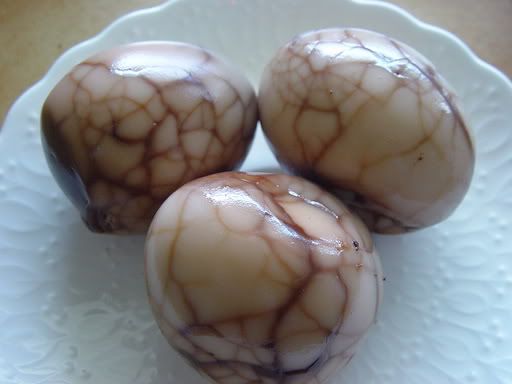
A popular snack is marbled tea eggs, where eggs are cooked in tea and Chinese herbs so they absorb the flavours. The eggs are lightly cracked all over and boiled in the tea to get the marble effect. In Malaysia, it is easy to make these eggs as the Chinese herbal shop can pack all the ingredients for you and all you need to do is just boil them. In Indonesia, it seems they also have their own Marbled eggs version, which they use colouring to get the marbled look.

Image hosted by Photobucket.comImage hosted by Photobucket.com
Left: Tea Eggs being prepared, Right: Tea Eggs - uncracked

Steamed Eggs

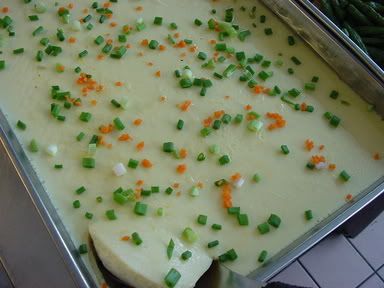
Steamed eggs feature prominently in Chinese food and is extremely popular at Chinese economy stalls that serve a selection of home cooked food at reasonable prices for lunch and dinner. As eggs are relatively cheap, these stalls will have several varieties and the popular ones are plain steamed eggs or steamed eggs mixed with minced meat. Another steamed egg dish that is popular has the three eggs; salted egg, century egg and hen's eggs. Besides these dishes, you can also add eggs to soya bean milk to make your own steamed egg tofu. Steamed egg custards can also be made as dessert where you steam them with milk and ginger. If you go a town up north called Ipoh, this is readily available in coffeeshops.
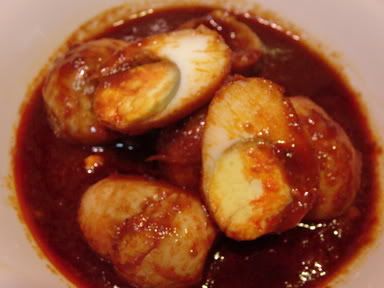
Image hosted by Photobucket.comImage hosted by Photobucket.com
Left: Plain steamed egg, Right: Steamed egg with minced meat

Egg Combinations

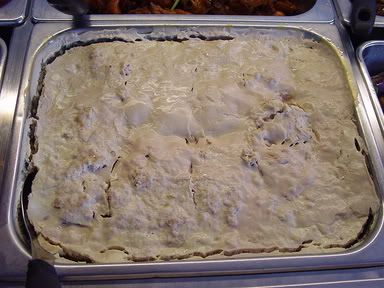
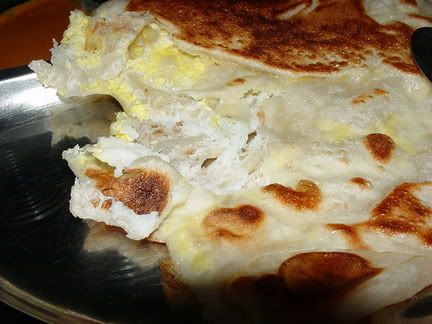
As eggs are seen as a source of nourishment, they can be added to existing dishes. In most hawker stalls that serve rice or noodle dishes, it is not unusual for you to add one egg into your serving especially if you feel the portions are too small for your liking. Roti Canai which is extremely popular in Malaysia has several versions and this one has an egg added in it to create Roti Telur which is enjoyed with some curry.

Image hosted by Photobucket.com
Roti Telur

Half Boiled Eggs

When I was young, my mother always insisted we take one half boiled egg before we went to school as additional nourishment. While I gobbled mine up, I still can remember my sister scrunching up her face to eat them as she hated eating eggs that way.

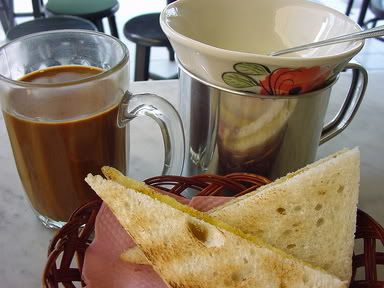
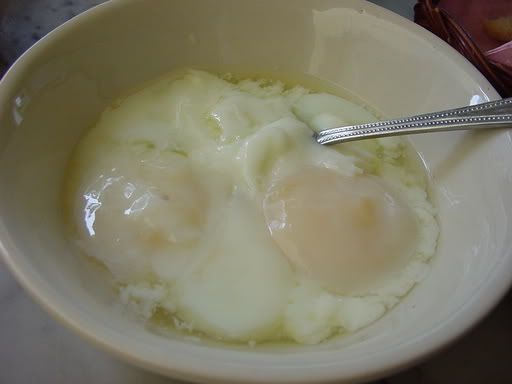
Nowadays half boiled eggs are back in high fashion as people flock to kopitiams (old coffee shops) to eat toasted white bread with butter and kaya, half boiled eggs and a cup of local coffee. The traditional way of making half boiled eggs at these kopitiam shops in to place the eggs in an enamel jug and pour boiling hot water to cover them. Leave them for about ten minutes and it is ready to eat. If you want to expedite the cooking process you can cover it as per the picture so it may take five to six minutes. Your eggs must be small size, extremely fresh and at room temperature.
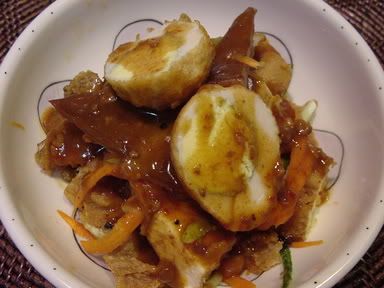
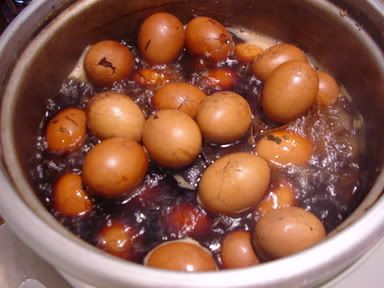
Image hosted by Photobucket.comImage hosted by Photobucket.com
Left: The breakfast set with coffee, toast with kaya and half boiled eggs, Right: Eggs - unveiled

Eggy Desserts

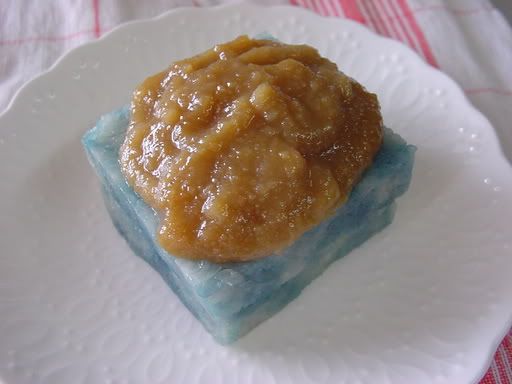
Eggs are also used in desserts and one popular way to cook them is to make kaya which is coconut egg jam. The process of making kaya is quite tedious as you need to boil the eggs with coconut milk in a double boiler for quite a long time at low heat. It will thicken and caramelised into a brown jammy substance. Sometimes, pandan juice is added to flavour kaya. It is used to spread on toasted bread and in this instance paired up with a Nyonya cake called Pulut Tai-Tai, that is glutinous rice coloured blue and white.

Image hosted by Photobucket.com
Pulut Tai Tai with lashings of kaya on top

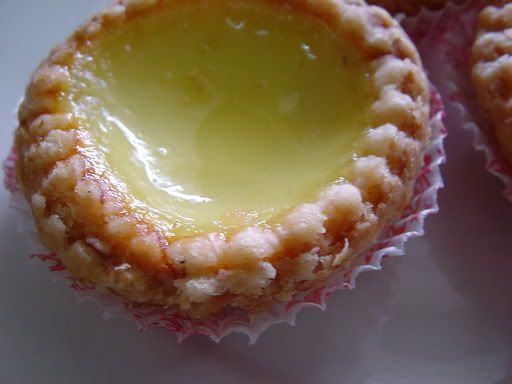
Another amazing eggy dessert is the egg tart, where the pastry surrounding the eggy custard is flaky and melts in your mouth. This egg tart is from Tong Kee Confectionery which has been serving egg tarts for the longest time ever. When I was a kid, we always had these egg tarts for tea. Till now, that tradition still continues and the quality of their egg tart has remained unchanged.

Image hosted by Photobucket.com
Oh so flaky egg tarts

Eggs as Wrappers

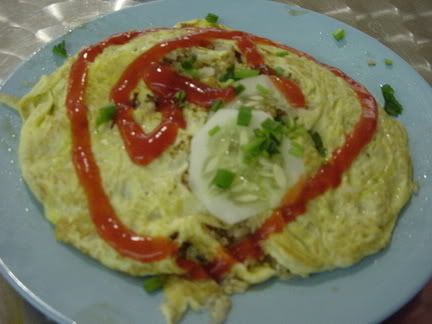
Eggs can also be used as a wrap for your food that look beautiful and also adds nourishment to your meal. A popular dish in hawker stalls is this Nasi Pattaya (Malay for Pattaya Rice) where fried rice is placed inside an omelette that is shaped like a pouch. Break open your egg pouch to get to your piping hot fried rice. This is also another Thai influenced dish that is now a permanent fixture in our roadside hawkers as a quick and easy meal.

Image hosted by Photobucket.com
Nasi Pattaya with chili sauce

Eggs as tradition

Besides using them as delicious dishes, eggs are also used as traditions in Malaysian culture. The Malays like to distribute the bunga telur (Malay for flower egg) during weddings to their guest together with a hard boiled egg. The egg is said to symbolise fertility and the hope that the marriage will produce many children.

For the Chinese, they will distribute red eggs on the baby's full moon or first month anniversary that symbolise new life and good luck. Red eggs are also made for birthdays as a symbol of prosperity and happiness for the birthday boy/girl.
Related Posts Plugin for WordPress, Blogger...