Friday, June 17, 2005

FrYdAY FiSh

Ever since I studied in England, I always associate Fridays with fish. This is because during my first year in university, I stayed in catered halls of residence and they had these little English traditions; fish, chips and peas on Fridays, roasts for Sunday lunch and a cold meal for Sunday dinner. My hall of residence was also quite unique as we had sit down dinners at 6 p.m.. This meant that you had to be on time for dinner or else no food and you sit at tables with 6 to 8 people. For the first few times, I was always stared at as I ate too slow compared to my English counterparts so I had to learn to eat quickly so they could clear for the next course. I must admit that after a few months of eating fish on Fridays, I got so sick of it and I used to skip Friday dinners and opt to go out to eat a curry instead.

Since it is Friday today, I thought of posting something about fish. I had this a few days back as my mum had bought this fish in the market. Don't ask me what kind it is as I am hopeless in identifying fishes! That is part of the reason why I rarely buy fish in the market. Another reason is Splashie Boy hates fish with bones!

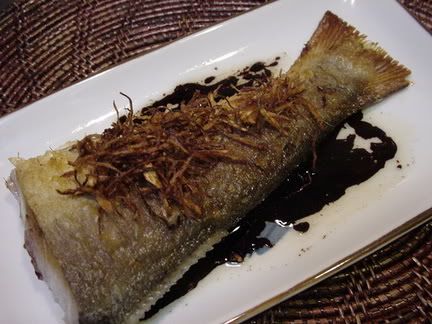
As per my mum's instructions, she said this kind of fish is the frying type and not the steam kind. Pretty simple stuff to fry up, just make sure your fish is dry and sprinkle some salt over both sides. Then heat up your wok and put some oil in it. Make sure your wok and oil is smoking hot before you put your fish or else the skin will stick to the wok. This time round, I got it right and my fish came out perfectly. Earlier, I had shredded some young ginger which I had deep fried so I sprinkled some on my fried fish. The sauce is just a mixture of black soya sauce and water which I heated up in the wok with a bit of the oil to loosen it up. I always prefer the tail side as I am hopeless in eating the fish head.

Image hosted by Photobucket.com

Thursday, June 16, 2005

YoU SaY ToMaTo, I SaY ToHmAtO

Not sure if you all noticed but I love vegetables and another one to add to that long list of I must haves are tomatoes or tohmatoes, whichever way you want to call them. Besides eating them fresh, I love them roasted as they go soft and gooey inside.

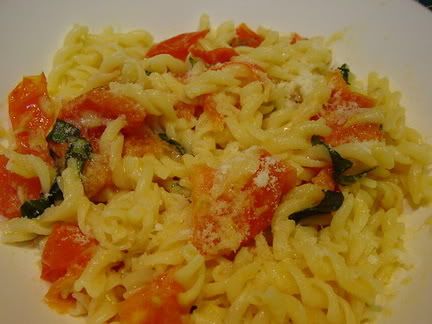
Roasted tomatoes are really easy peasy and the best thing is all you do is chuck them in the oven and you can go do other stuff while it cooks down. All you need to do is some good quality tomatoes - cut in quarters, garlic cloves (left whole), some herbs (dried or fresh), salt and pepper. I love lots of garlic, they taste sweet after you roast them so I always chuck in a lot. Just toss all that in some olive oil and plonk them in your oven, at say gas mark 5/200C for about half and hour to 45 minutes depending on how cooked down you want them.

Once done, I squeezed the soft garlic out from the cloves then mash them up to make some kind of sauce. Toss the roasted tomatoes and mashed garlic into your cooked pasta (whichever shape you want - it's small spiralis for us this time round). Add the pasta water (water from the pot you boiled your pasta in) to toss to create some moisture. You can also drizzle some olive oil to loosen it up. Shred some basil leaves for additional flavour and grate lots of parmesan cheese over your pasta. The flavours are light and not so heavy compared to the normal tomato sauce.

Besides adding them to pasta, I also use roasted tomatoes in a variety of ways; crack in some eggs to cook at the last minute so they're soft and the centers are still runny - extremely yummy with some bread. For those who have eaten at those char chan teng (Hongkong style cafes) where they serve baked rice, I do my veggie version of it by putting roasted tomatoes on top of cooked rice, drizzle some barbeque sauce and then top it with cheddar cheese which is melted under the grill. The char chan teng places use mozzarella cheese which is more stringy but I don't like the taste so I use cheddar instead.

Image hosted by Photobucket.com

Wednesday, June 15, 2005

ChEaT's ToNg YuEn

Eating tong yuen (Chinese for glutinous rice balls) is the tradition during Dong Zhi (Chinese for the Winter Solstice festival) as it brings you good luck. Legend claims that in Ancient China, a poor family caught a fish to celebrate Dong Zhi but in her haste to eat it, a fish bone was stuck at the mother's throat causing her discomfort. A beggar approached them for food and the daughter gave the fish as that was the only food they had. Seeing the mother's discomfort, the beggar gave her lumps of dough which she shallowed and got rid of the fish bone. After hearing this, the villagers believe that eating tong yuen will help ward of bad luck and that tradition has persisted till modern day.

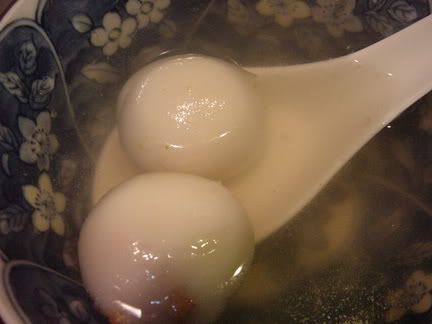
Although it is not Dong Zhi, we always eat tong yuen whenever we go to a dessert shop as we love it. One day, we discovered these frozen tong yuen at the supermarket and thought hey, they look so simple to get ready so why not try them? We did and I must admit, the taste of the rice balls is the same as those ones in the dessert shop. The brand we usually buy is KG Pastry and they have red bean paste, black sesame paste and peanut paste tong yuen. Now, we end up stocking up a few packets of frozen tong yuen in the freezer so whenever we feel like having it, it is ready in no time i.e. a perfect cheat's dessert!

We always drink ours with hot ginger syrup, some people usually accompany their tong yuen with pandan flavoured syrup or soya bean milk. The ginger syrup is easy to make, just peel and slice some young ginger, put in boiling water with sugar. Boil for about 10 minutes to let the flavours develop and serve boiling hot with your tong yuen which have been boiled seperately in hot water until they float up to the surface. The ones below are stuffed with peanut paste but our all time favourite is still the black sesame ones.

Image hosted by Photobucket.com

Tuesday, June 14, 2005

Oh My DaRLiNg PiNeAppLe

Pineapple is something I'm mad about - I love to eat them and one of friends teases me all the time about it and even nicknamed me Pineapple before as a joke in the office. I love to eat them freshly cut with a sprinkling of those sour fruits powder you get at the fruits stall or with black soya sauce mixed with some sugar. Besides that I love pineapple jam tarts - especially the ones my mum makes called pineapple balls as they melt in your mouth.

Pineapples are grown in Malaysia where the varieties are either for canning or the table. Popular table varieties are the Morris, Sarawak and Josapine which is the fruitition of our local agricultural board, Mardi. Besides the local varieties, the Thai pineapple is also extremely popular as it is sweeter and has less fibre. Eating pineapple is great when you have flu as it has loads of Vitamin C. It also helps your digestive system and can reduce inflamation of your wounds. However, if you are pregnant, eating pineapple is taboo as it is believed to induce abortion.

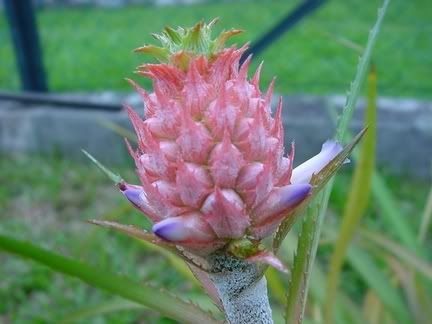
This is a decorative pineapple plant we have in the garden. It sprouts these mini pineapples that are so cute but unfortunately not edible.

Image hosted by Photobucket.com

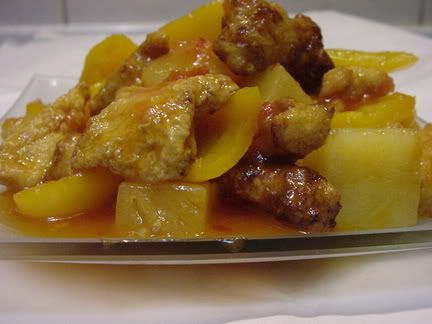
I made some Pineapple Chicken recently - it's like sweet and sour chicken except they add pineapple in the dish. Simple stuff to serve up. It looks extremely pretty if you have the "traffic light" colours i.e. the green capsicum, red tomato and yellow pineapple but my dish turned out a bit too sunshine yellow as I used yellow capsicum. Some fried chicken bits of mine were more brown than the others as I got slightly interrupted when I was frying them. I also omitted the fresh pineapple since I only had the canned variety.

Pineapple Chicken(from Hawkers Fair)

500g chicken breast or thigh, thinly sliced
4 pieces of pineapple rings from the can, cubed
150g fresh pineapple, diced
1 capsicum, sliced and preferably green
1 tomato, cut into wedges
cornflour for coating the chicken

Marinade
1 tsp salt
1/2 tsp sugar
1 egg
1 tsp curry powder
1 tbsp corn flour

Sauce
1 tbsp Thai Chili Sauce
1 tbsp tomato sauce
1 tbsp chili sauce
3 tbsps pineapple juice
1 tsp lemon juice
1 tbsp sugar
1/2 tsp salt

Mix the marinade ingredients and combine it with the sliced chicken. Leave it for 30 minutes. Coat with corn flour and shake the excess flour out. Deep fry in hot oil till golden brown. Ladle out and drain the oil away. Leave 1 tbsp of oil in the wok, put in pineapple, capsicum, tomato and stir well. Add the sauce and cook until thick. Add in the fried chicken and stir well. Dish up and serve with hot rice.

Image hosted by Photobucket.com

Sunday, June 12, 2005

SuiSSe StEaK

Recently we have been eating out quite a lot, which is great as it means no kitchen duty! One of the places we went for a certain special occasion was La Suisse, Plaza Damansara. Usually I am trigger happy when I get in a restaurant and sometimes, I ask the proprietor permission to take pictures. I can't really take spy pictures of the food as the camera we use is super huge and bulky so we do exercise discretion depending on how busy the place is. However, that night I decided to take a rest from picture taking and had also decided not to blog about it since there were no pictures. Coincidentally, the local paper, New Straits Times did a feature on the restaurant this week and they had pictures so I thought I will piggyback on their article.

La Suisse is an old time favourite of Splashie Boy and I, we love the food there especially the steaks which they do real well. You always bump into someone you know there and the last time we visited the restaurant, we met our veterinarian and his wife. However, with me cooking most of the time now, we have not visited the place for some time so it was wonderful going back there again. We found the quality to be just as great with some mini changes to the menu.

For starters, we always have the hot swiss cheese to share, it is just some swiss cheese melted and served with boiled potatoes, pickled onions and cornichons. The menu for mains is almost the same from last time except they now don't have my favourite lamb sirloin so I chose the beef fillet instead with a brandy herb sauce. Splashie Boy had the beef sirloin with mushrooms. La Suisse now serves Black Angus beef from Argentina in addition to their usual Australian beef. We decided to go for the Black Angus which was superb, real melt in the mouth stuff. The best thing about La Suisse are their sauces, they taste divine! My favourite is their herb sauce with just a dash of brandy. Nowadays the sauce comes seperately so you add on as much as you like. No desserts for us that night as we were stuffed to the brim with the good food.

La Suisse Restaurant
Plaza Damansara
Damansara Heights
Kuala Lumpur
Tel No: 603 - 2094 6587


*Disclaimer: The opinions expressed here is entirely based on my personal tastebuds and may vary for others. The reviewer also declares that she has not received any monetary or non-monetary compensation for writing this review.

Saturday, June 11, 2005

DrAgOnBoAtS & DuMpLiNgS

Today is the Dragonboat and Zongzi (Mandarin for dumpling) festival which falls on the fifth day of the fifth month of the Chinese Lunar calendar. The tradition of the dragon boat and making of dumplings can be traced back to the famous poet Qu Yuan's suicide in protest of corruption in China. When the locals heard about his suicide in the river, they rushed out to search for him in their boats, beating the water with their paddles to keep the fish and evil spirits from his body. They also scattered rice grains in the river to try and prevent the fish from eating his body. However, one night Qu Yuan's spirit appeared before his friends and said that the rice meant for him was intercepted by a water dragon and he instructed his friends to wrap the rice in three cornered silk packages to ward off the dragon. This tradition of beating the water with the paddles has now become the famous Dragonboat races where people compete in boats that they paddle just like before to look for Qu Yuan's body. In Hong Kong and Penang, races are being held this weekend for the festival where different teams will compete. The dumplings are made till today although not in silk but from bamboo leaves and are enjoyed by everyone.

Dumplings today come in many varieties and each Chinese clan have their own traditional dumpling. As my mother is Hokkien, we usually have the Ham Yuk Chung (Chinese for Salted Pork Dumpling) which my aunt makes every year. My aunt has been making dumplings for almost 40 years and she even goes overseas to Vancouver and Melbourne to make it for her kids who have migrated there. I was lucky to witness her making a batch of dumplings recently but as she is a fast worker, I could not really get her to slow down and let me take step by step pictures.

Here are the filling of the dumplings, my aunt uses yellow mung beans, rice grains which she has fried to give it colour to the dumplings, salted egg yolks, pork, mushrooms and chesnut which have been cooked earlier.
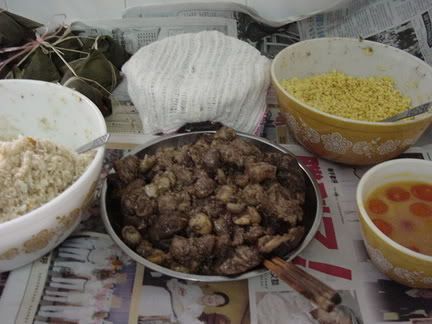
Image hosted by Photobucket.com

My aunt has steamed and soaked the dried bamboo leaves earlier. These are cleaned and wiped dry before she starts using them to wrap the dumplings. She uses two leaves that intersect in the middle that she shapes in a cone to add the rice. It looked so easy when she did it but later when she showed me how to do it, I had so much trouble making the cone big enough for the fillings.
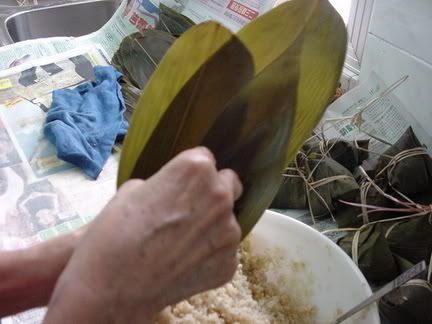
Image hosted by Photobucket.com

After you add a layer of rice, put in the a piece of pork, mushroom, salted egg yolk and chesnut. Add the yellow beans on top and top with rice. Then you fold the leaves across to make a pyramid shape and turn the flap down as below. Keep it tight so your fillings do not fall out.
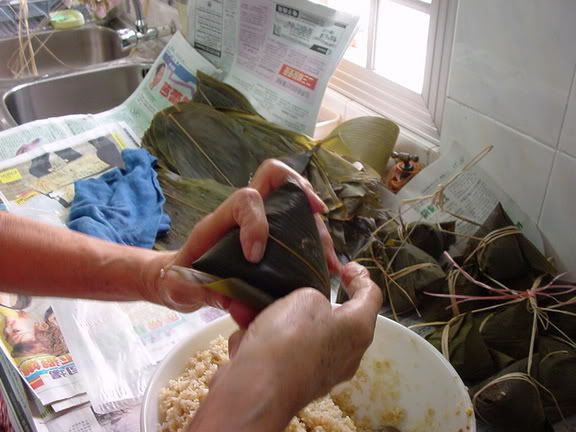
Image hosted by Photobucket.com

Then you tie it up with hemp string which you should hook up somewhere as it is easier to tie it up. You can tie as many dumplings you like on each hemp string bunch. Once you finish making your dumplings, you will need to boil the dumplings in a big pot of water for four hours. Make sure your water is boiling at all times and you will need to monitor it to top up the water. There are supersitions that say that if a pregnant woman enters the kitchen when the dumplings are being boiled, it will never cook.
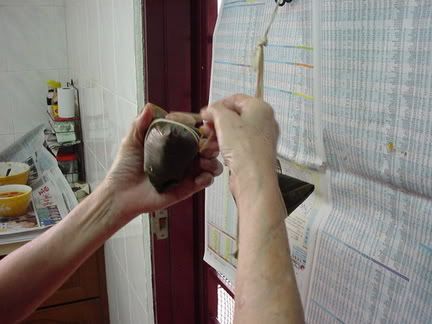
Image hosted by Photobucket.com

Besides the Ham Yuk Chung we get from my auntie each year, we also buy Nyonya dumplings from this old lady in Sea Park, Petaling Jaya. Recently we visited her at her house to get some dumplings and her house is a mini dumpling factory. There was a man helping her prepare the bamboo leaves, here he is soaking the bamboo leaves in a tub.
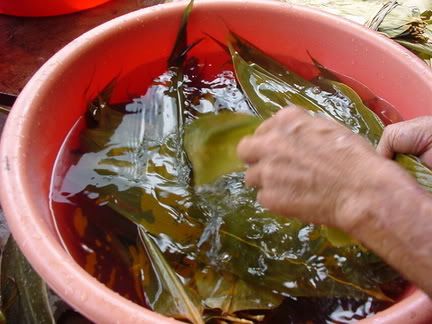
Image hosted by Photobucket.com

This is the auntie making the Nyonya dumplings, the filling is a mixture of pork, tau cheow (Chinese for bean paste) and winter melon. She has been making dumplings for 30 years for her business and because she sits down to make them, her back is hunched.
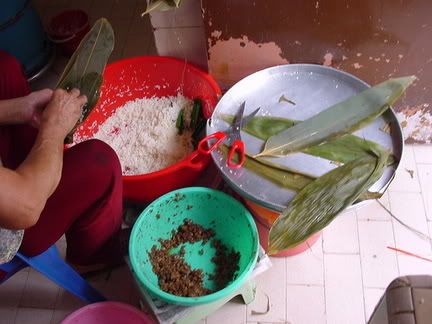
Image hosted by Photobucket.com

This is the huge pot they boil dumplings in.
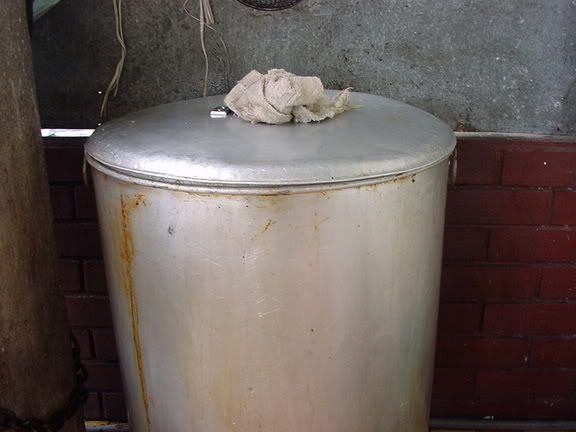
Image hosted by Photobucket.com

Piles and piles of dumplings at her house. Besides Nyonya dumplings, she also makes the Kee Chang, which is made from alkaline water that have red bean fillings.
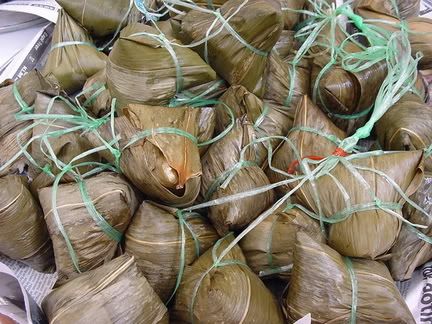
Image hosted by Photobucket.com

My aunt's dumpling unveiled! Some Hokkiens put dark soya sauce to make their dumpling darker and they have lots of dried oysters as it is fatt (Chinese for good luck).
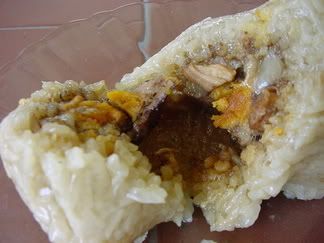
Image hosted by Photobucket.com

Nyonya bak chang's yummy insides revealed. Traditionally the dumpling has a bit of blue rice coloured from the butterfly pea flower but nowadays people use blue food colouring instead.
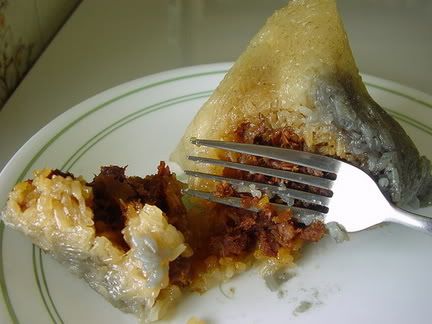
Image hosted by Photobucket.com

Besides these dumplings my favourites are the Kee Chang made from alkaline water and glutinous rice which you can get plain and with red bean fillings. I love them plain as you can eat them with gula melaka (Malay for palm sugar) syrup or kaya (egg custard). The best Kee Changs I have tasted are the tiny ones they sell in Haadyai which come in big bunches. The Kee Changs taste nicer in Thailand as the glutinous rice grains they use is of better quality than the ones found in Malaysia.

I have a really strange habit of eating my dumplings, I always have it with a spoonful of sugar. Not sure why or whether there is any tradition to it. Nowadays, I sprinkle just a bit to add some sweetness to the dumplings.
Thursday, June 09, 2005

TaIwAnEsE BeeF NooDlEs

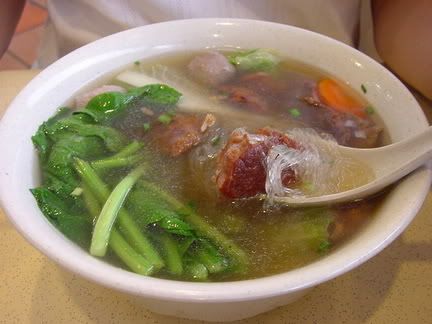
We discovered these yummy Taiwanese beef noodles sometime last year when we made a trip to Ampang Point shopping centre. As we rarely go to Ampang, originally we were planning to eat some Korean food at the Korean Town in Ampang. However, a quick word with our friend who owns a shoplot in Ampang Point diverted us to this beef noodles joint which he highly recommended. Since then, this place has been an absolute must for us and we make special trips to Ampang just to eat the yummy beef noodles.

Their first outlet is located on the first floor of Ampang Point and they are seriously running out of space to put tables and chairs for their customers. Our last trip there, we found out they had also taken another shoplot outside the shopping complex which is just as packed. The shoplot is much better as it is less claustrophobic compared to the one in the shopping complex.

The menu is quite simple, they serve beef noodles (dry and soup) with mee and glass noodles. They also have chicken noodles, noodles with dumplings, fishball noodles, rice sets, chicken wings, dumplings and etc. The noodles come in sets where you pay RM9 for a huge bowl and a drink (chinese tea or winter melon)

I always prefer the soupy noodles as I love the hot soup and the tons of vegetables inside (Kailan, chinese cabbage, carrot and white radish). The beef comes in huge chunks and is super tender and flavoursome. I had the beef with glass noodles below, the glass noodles is nice and not as filling as the normal mee.

Image hosted by Photobucket.com

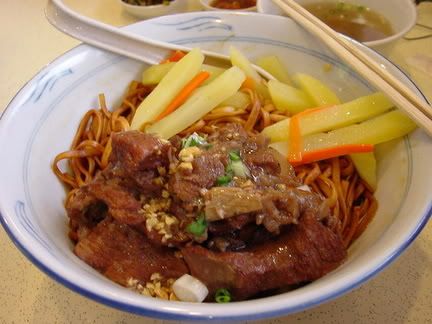
Splashie Boy always eats the dry beef noodles ( he hates soup as he says it is too hot), see the chunks of beef, the slices of potatoes and carrots. I tend not to eat the dry noodles as I can make an absolute mess of myself while eating it!

Image hosted by Photobucket.com

Taiwan House Restaurant (Ampang)
Lot F31, 1st Floor
Ampang Point Shopping Centre
Jalan Mamanda 3
68000 Ampang
Tel:603 - 4251 5131

75, Jalan Mamanda 1
Ampang Point
68000 Ampang
Tel:603 - 4252 2389

*Disclaimer: The opinions expressed here is entirely based on my personal tastebuds and may vary for others. The reviewer also declares that she has not received any monetary or non-monetary compensation for writing this review.

Wednesday, June 08, 2005

QuIcKiE FooD

Some days, depending on my mood, all I want is a quick one bowl meal. A bowl of hot noodles always seem to satisfy my hunger pangs and is ultimate fast food for me.

I tend to stock up various noodles and pasta in my larder (shows how indecisive I am as I have a lot!) - linguini, penne, macaroni, beehoon (Malaysian for vermicelli), instant udon noodles, instant noodles (favourite is Indomie Goreng), buckwheat noodles and dry thai kuay teow noodles. I love these dry thai kuay teow noodles which I keep to make pad thai (thai fried noodles) or soup noodles. They are so simple to cook, just boil some hot water and pour it over the dry noodles and cover for about ten minutes. Rinse under cold water and ta-da, you can have kuey teow noodles.

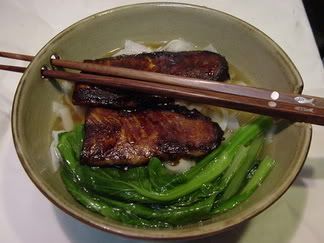
Like I mentioned before, I always have some fried ikan bilis (Malay for anchovies) courtesy of my auntie so making a soup base is quite fast, just pour in boiling water to the ikan bilis and simmer the stock for a while to the flavours develop. Once you got your soup and noodles, all you need to add is the vegetables and your fish. You can opt for meat also but since I had fish fillets in the freezer, I grilled them using Nigel Slater's recipe from Real Cooking.

Grilled Fish
3 tbsps dark soya sauce
2 tbsps sake
2 tbsps mirin
A clove of garlic, crushed
1 tsp sugar

Mix ingredients in a shallow bowl and marinate fish fillets (about 200g) in mixture for about 30 minutes to 1 hour. Remove from marinade and grill fish fillets until cooked. Top noodles and blanch kailan in soup and serve.

Image hosted by Photobucket.com

Tuesday, June 07, 2005

MiLkShAkE aNyOnE?

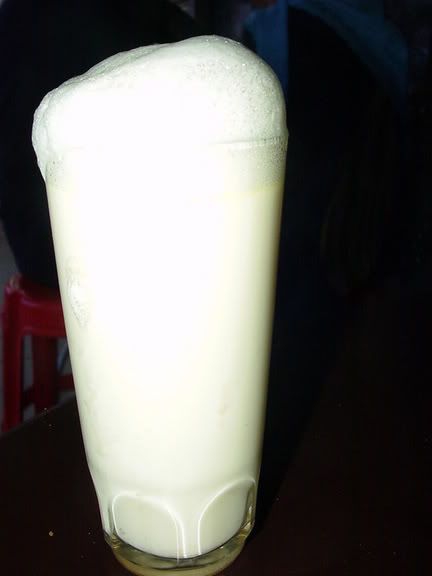
Recently I had a tall glass of slightly warm fresh cow's milk shaken but not stirred at the *mamak stall. It was my first time drinking it as a friend of ours, Mohan offered to order this Indian delicacy for me. He told us that the froth on top is very valuable and sometimes, you get little bits of cream on top. This one was not that creamy but it is amazing how it froths up so beautifully like a capuccino.

The Indians love fresh cow's milk and some ancient Indian texts even call it amrita which means nectar in Indian. Ayurvedic medicine texts claim that cow's milk is good for building vitality and can cure uric acid problems in your stomach. It is also said to help prevent heart disease.

So next time when you want a health cure, try our local milk shake a.k.a fresh cow's milk?


Image hosted by Photobucket.com

* Not all mamak stalls serve fresh cow's milk. This is from the Nasi Kandar Penang in Petaling Jaya New Town (next to HSBC Malaysia Berhad's Petaling Jaya branch)

Monday, June 06, 2005

CHiLdHooD MeMoRiEs

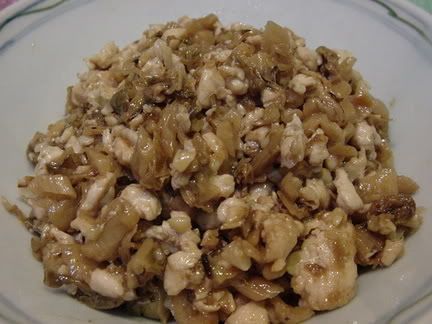
Nostalgia is kicking in for me, must be my old age! It has been a few years since I have eaten a home cooked meal by my mum and I suddenly had the urge to eat those simple but hearty dishes she used to cook for my dad and I. Recently I managed to get her to teach me how to make this childhood dish, mui choy (Chinese for preserved mustard cabbage) with minced chicken. Wow, when I ate this dish, it sure brought back happy childhood memories.

There are two kinds of mui choy, salted and sweet which are brought in from China. You can get them from the Chinese dried good shops in wet markets or even supermarkets. For this recipe, we used the sweet kind which required less soaking in water.

Mui Choy Minced Chicken
100g chicken fillets, diced in small cubes
4 cloves garlic, minced
1 knob of ginger, minced
2 shallots, minced
1 piece of sweet mui choy
soya sauce
salt
cornflour
white pepper
sugar
oyster sauce

Cut the chicken fillets into small cubes. Marinate it with a dash of soya sauce, pinch of salt, 1 tsp cornflour, a dash of white pepper. Put aside and prepare your mui choy. Wash the mui choy thoroughly in running water. Take care to wash the leaves as there may be sand. Soak in a bowl of water while you mince the garlic, ginger and shallots. Once completed, wash to mui choy and squeeze the water out. Chop the mui choy finely and squeeze it again to make sure it is dry.

Heat up the wok (do not put oil inside) and fry the chopped mui choy to get rid of any moisture. Keep stirring it around to avoid it burning for about two to three minutes. Take out the mui choy and put aside. Heat the wok and 1 tbsp of oil. Fry the minced ginger, garlic and shallots until fragrant. Add the minced chicken and brown the chicken. Use the spatula or chopsticks to break the chicken in small pieces. Once the chicken is brown, add the mui choy and mix them together. Add a bit of water, about 3 tbsps and let it cook on medium heat. Add 1 tsp sugar in the mixture and mix thoroughly. If the water dries up, add some more water. Don't put too much water or else your mui choy will be soggy. Mix 1/2 tbsp oyster sauce with 2 tbsps water and 1 tsp corn flour. Pour in the mixture and mix thoroughly. Once it boils, turn off the heat. Note that the mui choy should look quite dry with the sauce clinging on the mixture only. Dish up and enjoy with piping hot rice.

Image hosted by Photobucket.com

Sunday, June 05, 2005

EaSy PeAsY SoRbEt

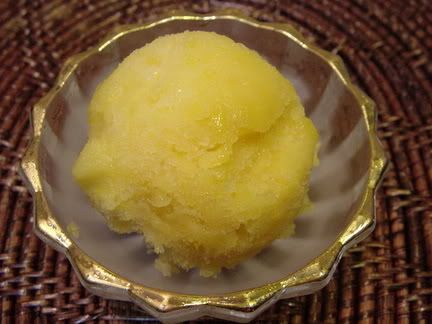
I got my May issue of the BBC Good Food magazine recently after a long wait as I missed the first batch of issues that usually come in just before the May. Thumbing through my copy, I was so excited to read this tip from Paul Merrett on how to make the easiest peach sorbet ever. I call sorbet a poncy (British slang for fancy) dessert as I remember eating my first sorbet in Lafite, the posh French restaurant in Shangri-La Hotel when I was a teenager. Being a total green horn, I thought having dessert halfway through the meal was so much fun even though I was told that it cleared your palate. At that age, who cared about palate! Nowadays I am more into sorbet since it is devoid of cream and is less fattening than ice-cream.

It looked so easy that I went to the supermarket to search for canned peaches in juice. Not an easy task as it seems that most supermarkets only have canned peaches in syrup. So far, I only found two places, one is in Ampang Grocers that usually has funny stuff in stock as they cater for the expatriate crowd in Ampang and Tescos which brings in their own canned goods that includes canned fruits in juice.

Peach sorbet
1 can of peaches in juice

Open can and pour contents into a plastic container (any old ice-cream container will do) and put it into your freezer overnight. Take out the container few minutes before you want to serve the sorbet. Since our weather is so hot, it is advisable that you put your serving bowl in the freezer for a short while. This helps to prevent melting when you scoop your sorbet into it. Cut the frozen peaches and juice in small chunks and blend them. Place them back in the plastic container and press down to make it even. Use an ice-cream scoop to scoop it into balls and serve on your frosted bowls. Note that the peaches in juice is not so sweet so you may find it slightly tart.

I thoroughly enjoyed my sorbet and I reckon I may try to make some more as Tescos has quite a wide variety of other canned fruits in juices. If you can't get canned fruits in juices, I guess you can replace the same quantity of syrup with fruit juice. Just make sure your fruit juice is not the thick concentrate type.

Incidentally Paul Merrett is currently hosting a new BBC food show called Ever Wondered About Food. The show looks fascinating with them examining the science of food, the history and the way we cook. How I wish we could watch it but I doubt BBC Worldwide will be showing it as it seems to be more catered for the British audience.

Image hosted by Photobucket.com

WeeKeNd BrEkkIe

Brekkie or breakfast is always a leisurely affair during weekends since it means eating it with Splashie Boy. Almost without fail, it's a weekly pilgrimage to the Indian restaurant for a good dosage of roti canai, thosai, dhal, sambal and sweet appams. Although there are loads of Indian restaurants or what we call the mamak man at every corner in Kuala Lumpur and Petaling Jaya, the quality of their food can vary. We have had total disasters with some that made the food inedible. One roti planta we had about two to three weeks ago was half cooked, dripping with margarine and had uneven sprinkling of sugar. Needless to say, we are not patronising that place ever again.

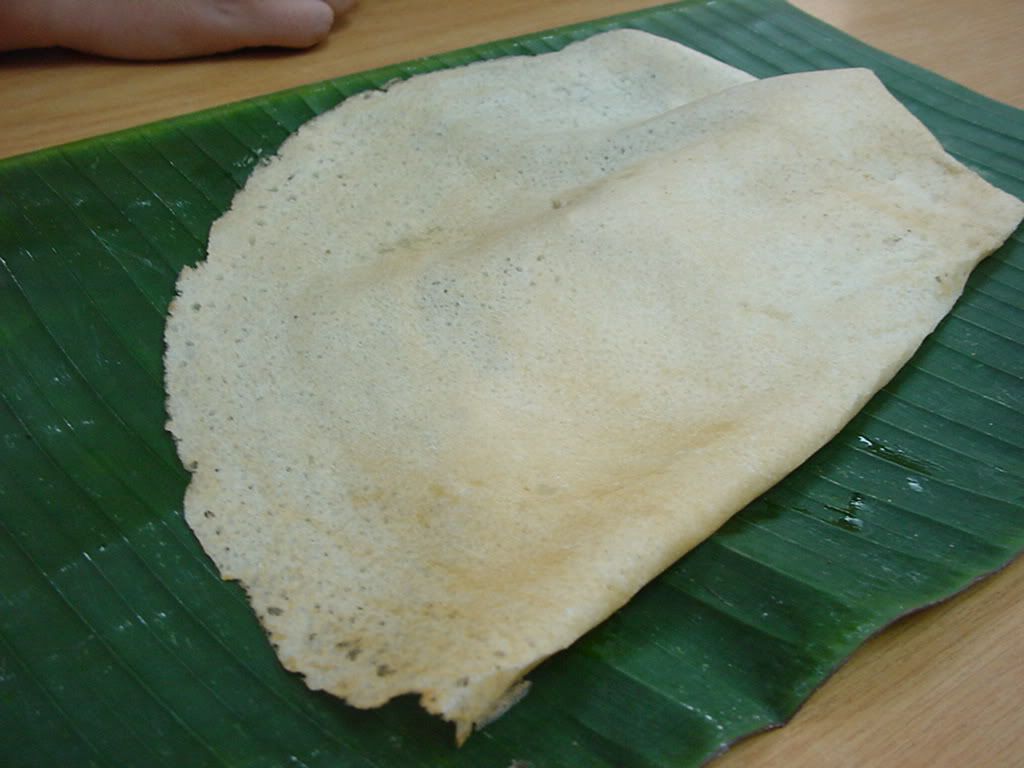
Since we eat so often at the mamak man for brekkie, we narrowed down two places we like and often go to. One place is at Sri Hartamas, just a little shack where they make the most wonderful thin and crispy roti planta. Splashie Boy loves roti planta, which is basically roti canai slattered with planta margarine and toasted on the skillet until it's crispy. The other regular spot we eat at is in Petaling Jaya as it's one of those few places that serve appams. Splashie Boy will have his regular roti planta while I rather eat the not so calorie laden thosai. The thosai is known as the South Indian pancake which is made from dhall and rice grinded together. The thosai has many varieties such as rava (where they add chopped green chilis and onions) and paper (where it's crispy and is shaped as a cone or rolled up like a big cigar). The one I usually order is a plain one.


Image hosted by Photobucket.com

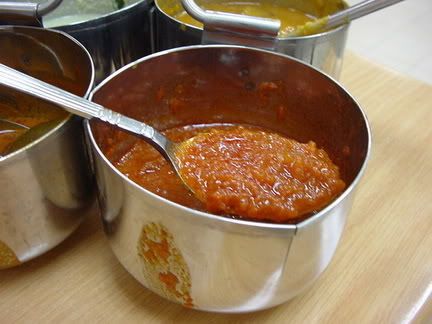
The thosai is nothing to shout about but what makes me really enjoy my thosai is eating it with their sambal (see below). It is not the watery stuff you get but laden with tomatoes and onions. I usually mix it with a dash of the coconut milk stuff they also give to reduce the spiciness of the sambal.

Image hosted by Photobucket.com

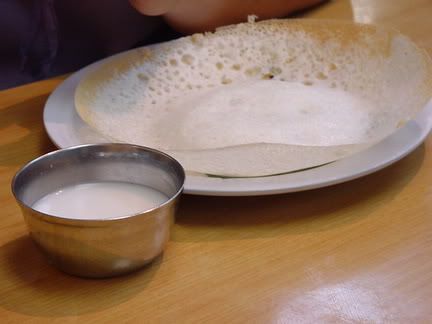
We always order the appam which is only available during the weekends or public holidays. It's like a crispy coconut milk pancake made from rice flour. They also give you a small bowl of sweetened coconut milk to dip your appam in. I love appams but they not available in most mamak shops so having it at this place has become a real treat.

Image hosted by Photobucket.com

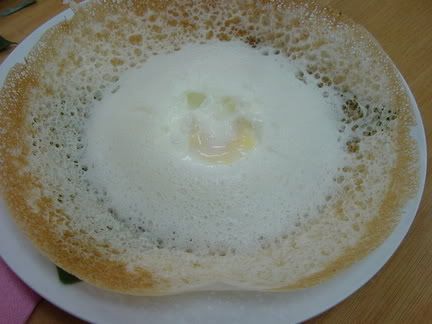
They also make appam telur where they crack an egg in the centre.

Image hosted by Photobucket.com

Besides breakfast items, the restaurant also serves pretty decent banana leaf lunch with some nice Chicken Varuval that I often eat with some chappati. We have also tried their dinner menu once with the usual tandoori chicken, chicken tikka and naans. Unlike other mamak shops, they cut their naan up in smaller pieces so it tastes crispier. Being a regular at this shop, we note that service can be a bit chaotic at peak times and sometimes quality of food can differ. For instance, we were late to breakfast today (about 11am) and the sambal was just not it's usual thick stuff but got watered down a bit as they were probably running low on it.

Manja Restaurant
No. 23, Jalan SS 3/29
University Gardens
47300 Petaling Jaya
Tel No: 603 - 7877 1814

*Disclaimer: The opinions expressed here is entirely based on my personal tastebuds and may vary for others. This is also the case for mamak shops as everyone has their own personal favourites for roti canai, thosai and etc. The reviewer also declares that she has not received any monetary or non-monetary compensation for writing this review.

Saturday, June 04, 2005

OyAkO-dOn

I have always been a fan of Japanese food and can basically eat most of the stuff they serve with the exception of natto (the sticky beans is just not me!). I love the donburi (Japanese for rice bowl) dishes and most restaurants in Malaysia do serve some of the basic donburi dishes like oyako-don, gyu-don (beef bowl), katsu-don (chicken cutlet) and ten-don (tempura). There are also raw fish donburis such as chirashi sushi (assorted raw fish), tekka-don (tuna sashimi) and ikura-don (salmon roe). With the raw fish donburis, the rice is especially nice as they mix in the rice vinegar so it's the same taste and sticky consistency as the rice used to make sushi.

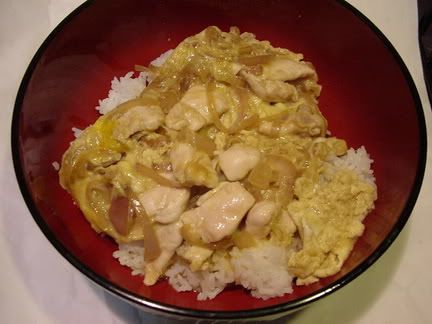
An easy to make favourite is the Japanese classic, Oyako-Don (Japanese for parent and child bowl) that is made from chicken and eggs, two staples in my kitchen. It's called parent and child since the parent i.e. the chicken and the child i.e. the egg are the main ingredients of this dish. I always have leftover eggs from my baking as I am quite "kiasu" (Singlish for fear of losing out) and like to buy extra just in case the egg is bad which throws a major spanner to my cake baking efforts.

My oyako-don recipe which is just nice for both of us comes from Quick and Easy Donburi Dishes that has multitude of donburi recipes. I usually don't add mitsuba since I'm not partial to it and have made slight variations of the recipe to fit my own taste.

Oyako-Don
3-4 cups of hot cooked rice
120g chicken thigh or breast, cut into cubes
3 eggs, lightly stirred
1/2 onion, sliced thinly
2-3 stalks of mitsuba
Cooking Broth
2/3 cup dashi stock
1 tsp sugar
2 1/2 tbsp soya sauce
2 1/2 tbsp mirin

Slice the chicken into cubes and the onion into thin slices. Select a saucepan that is almost the size of your bowl that you will be serving your oyako-don in. I usually cook each portion seperately as my pan is too small for two portions.

In your selected saucepan, bring the cooking broth to boil and add the onion to cook for two to three minutes at medium heat taking care not to boil away all the liquid. Once it is cooked to your desired consistency, add the chicken cubes. Spread the chicken and onions out in the pan and swirl in the lightly beaten egg. When your eggs are partially set (don't stir them during cooking), immediately remove from the heat and cover for about two minutes. Sprinkle some chopped shredded nori (Japanese for seaweed) on top of your rice and place the topping on the rice. You can also add some on top as decoration. Unfortunately, no nori in the fridge that day so my oyako-don looks a bit plain without it.

Image hosted by Photobucket.com

Friday, June 03, 2005

SwEEt SoUp

Tong sui (Chinese for sweet soup) is a popular Chinese dessert which can be taken hot or cold. Usually you drink it the day you make the tong sui as leftovers in the fridge is a no-no since the Chinese believe that you will get "wind" if you drink overnight tong sui. There are many varieties of tong sui but for me, the ultimate tong sui is leng chee kang.

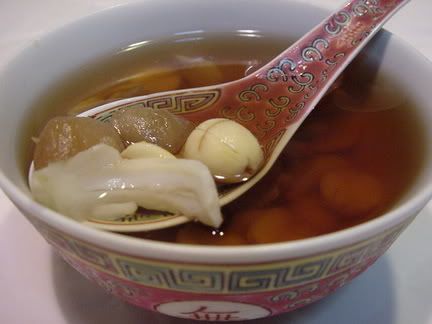
I love leng chee kang as it is full of all those good things in life; leng chee (Chinese for lotus seeds), dried longans, crunchy snow fungus and dried lily bulbs. It's readily available at the local hawkers and in restaurants that specialise in tong sui so satisfying my craving for it is pretty easy. Each outlet have their "special blend" of ingredients and some have additional ingredients like dried agar-agar strips, dried winter melon, sago or dried persimmon.

There are many different ways to make leng chee kang and I have been experimenting with the various methods. Recently I tried a recipe I got from a local magazine that featured a famous tong sui shop in Cheras. Since the recipe was for vast quantities, I adapted it to fit the two of us. The recipe is not entirely perfect and you will probably need further tweaking to fit your own tastebuds. The original recipe called for soaking the lotus seeds in alkaline water which I skipped since I did not have any alkaline water. I also omitted the snow fungus since I had ran out of it. If using snow fungus, remember to soak them for a while to soften them and snip off their dried hard bits. They also use ingredients like lor hon kor (Chinese for Buddha's fruit) and kam choh (Chinese for licorice root). Lor hon kor is a dried hard round fruit found in Chinese medicine shops. I'm not sure how the reference of Buddha but it is supposed to be good to keep you from feeling heaty. Pandan leaves are also used to lightly flavour the dessert with their wonderful smell.

Leng Chee Kang
100g lotus seeds
4 pieces of pandan leaf
rock sugar
water
50g dried lily bulbs
50g dried longan
1 Buddha's fruit (Lor Hon Kor)
a handful of kam choh

Boil the lotus seeds, water (up to you to add but I used about three to four rice bowls), 2 pieces of pandan leaf knotted up and rock sugar (the amount is up to you to add depending on how sweet you want your dessert to be) until the lotus seeds are soft. Add the dried lily bulbs and dried longan and boil for another half and hour. Lily bulbs cook faster than lotus seeds so don't add them together or else they will be too soft. I usually like my longans to still be whole and not so soft so I don't boil them for too long.

In another pot, add the slightly cracked lor hon kor, 2 pieces of pandan leaf knotted up and the kam choh with water(I used about five rice bowls) to boil. Once the colours have deepen and the aromas released, scoop the lor hon kor and kam choh out or else the mixture will be too strong tasting. Add rock sugar to taste and boil it further. Once boiled, add in more water to dilute the solution further until the taste is just right for you. You may add extra sugar if you like to taste.

To serve your leng chee kang, scoop the leng chee, lily bulbs and longan into a bowl and add the above mixture. If you want it cold, you can add some ice cubes to the tong sui.

Image hosted by Photobucket.com

Wednesday, June 01, 2005

HoNeY LeMMoNy FiSh

Another of those great combination of flavours is honey and lemon. Not only those it taste great in cooking but nothing beats a hot honey drink with a slice of lemon when I'm down with flu. It's comforting and good for that sore throat of mine that always bug me when I get the flu. Splashie Boy swears that honey can also cure coughs as he took a spoonful of honey in a plastic spoon daily last year when he had a bad cough.

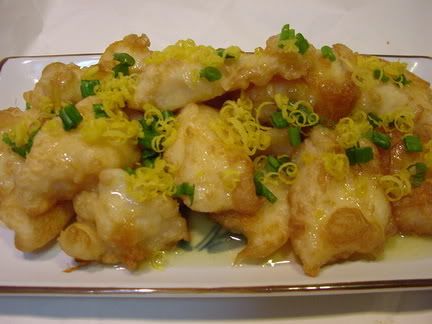
This recipe for the honeyed lemon fish fillets is courtesy of Gina from Kitchen Capers. When I mixed the batter, I was a bit sceptical as it was quite thick but after tasting the fried fish, the batter was nice and light. I omitted the oil for the sauce and added bits of lemon rind that gave a slight tang to the sauce.

Honeyed Lemon Fish Fillets

2 pcs of Dory fillets(cut into smaller pcs)

Batter mix: mixed together into a thick paste
3 tbsps plain flour
2 tbsps glutinous rice flour
1 tsp baking powder
2 tbsps water

Sauce:
4 tbsps fresh lemon juice
1 tbsp honey
1 tsp sugar
1 tsp corn starch mixed with 1 tbsp water

Heat up the wok with corn oil. Dip fish fillets into batter mix and coat evenly. Deep fry the fish fillets till golden brown, about 5 minutes. Remove from hot oil and drain on absorbent paper. In a frying pan, add 1 tbsp olive oil to heat, add the lemon sauce, stir fry until it thickens. Turn off the fire and pour over fish fillets. Garnish with chopped spring onions and lemon rind.

Enjoy with piping hot rice.
Image hosted by Photobucket.com

Monday, May 30, 2005

ShAnGhAi NooN

Recently Kuala Lumpur has been invaded by Shanghai food with many new restaurants cropping up such as Shanghai at the Marriott Hotel, Xin Shanghai at Jalan Sultan Ismail, Dragon I in Cititel Hotel and Chef Loong in Petaling Jaya. The latest one to join this illustrious lot is Crystal Jade La Mian Xiao Long Bao which opened its doors in Kuala Lumpur on 16 May, 2005 at Lot 10, Kuala Lumpur.

Already established in Singapore where they have numerous restaurants that serve a large variety of Chinese food, this marks Crystal Jade's first foray in Malaysia. My mother who has tasted their food in Singapore was enthusiatic when she heard they had opened a branch here so we went recently to sample the food for lunch and we were not dissapointed.

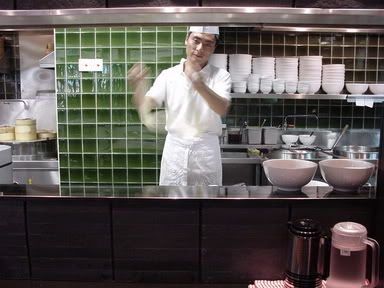
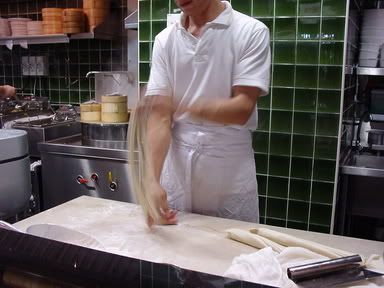
The restaurant has an open kitchen so we could peek in to see the chefs cook and make the famous la mian (Chinese for hand pulled noodles). Once we put in our order for a bowl, the chef started making our noodles, here he is tossing the noodles at quick speed that my camera can't even catch it!

Image hosted by Photobucket.com

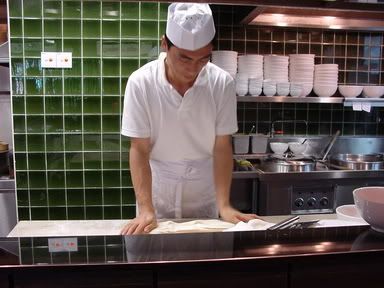
You need to toss and knead the dough to get the right consistency for the noodles. The chef is using the palms of his hands. He will fold the dough to get it ready to be pulled again.

Image hosted by Photobucket.com

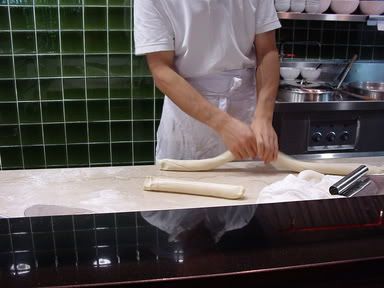
Here he is cutting the dough to be pulled again.

Image hosted by Photobucket.com

Then he starts pulling the dough at great speed again and after a while, thin strands of noodles appear which he will put in boiling water to cook.

Image hosted by Photobucket.com

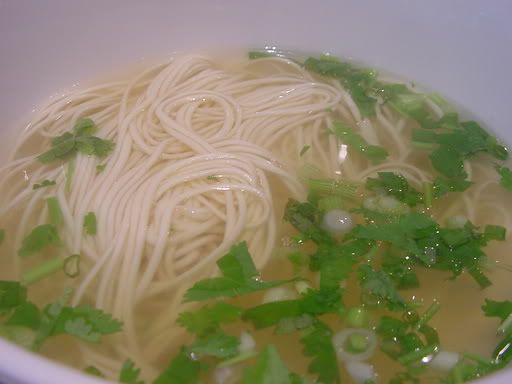
I was too slow to get the final bit where he came out with the noodle strands, in fact he surprised me as next thing I knew, after pulling it, the noodles just appeared from no where. Our bowl of piping hot la mian came plain and with a delicious soup. My bowl was still steaming hence you see the fuzziness in the picture as I quickly snapped it immediately after it was served.

Image hosted by Photobucket.com

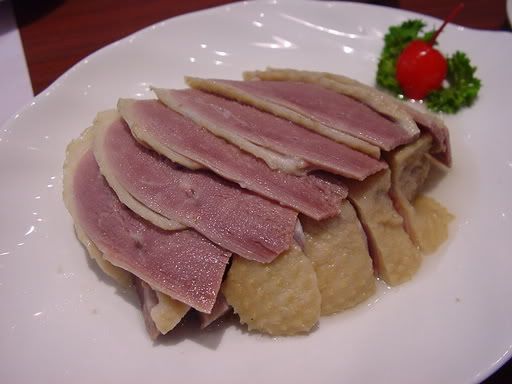
This is the Nanjing salted duck which was tender and flavorsome, just nice to accompany our plain la mian. Although it's soaked in brine water which helps it achieve the tenderness, it's not salty. It's a signature dish in Nanjing that has almost 400 years of history.

Image hosted by Photobucket.com

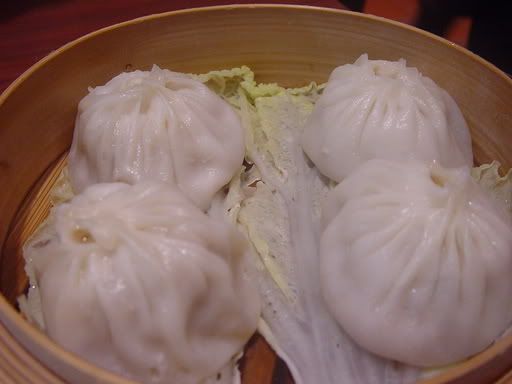
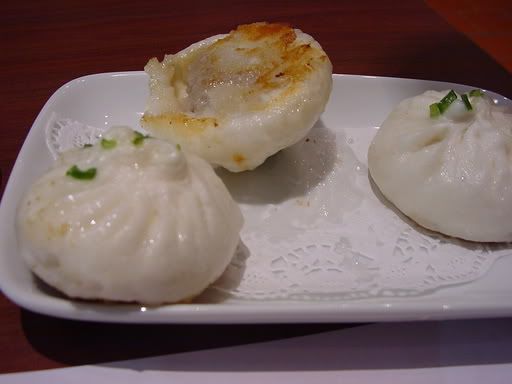
This is the famous Xiao Long Bao which is a meat filled steamed bun with hot soup inside. See the little hole on top of the steamed bun, that is for you to suck up the wonderful hot soup. The filling is so tender that it melts in your mouth!

Image hosted by Photobucket.com

This is a variation of the Xiao Long Bao called Shanghai Pan Fried Bun as it's pan fried instead of steamed. We flipped one over, so you can all see the golden edges from pan frying it.

Image hosted by Photobucket.com

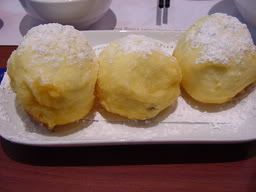
This is the ultimate cream puff, the souffle egg white ball with mashed red bean and banana dusted with icing sugar. It's so light and airy as it's made from egg whites and the filling is quite an unusual combination of red bean and banana. I never knew those two flavours went together until I tried it. If you order this dish, it comes first as the filling is piping hot so they let it cool during the meal just in time for dessert.

Image hosted by Photobucket.com

Crystal Jade La Mian Xiao Long Bao
R2 Annexe Block
Lot 10 Shopping Centre
50 Jalan Sultan Ismail
50250 Kuala Lumpur
Tel: 03-2148 2338
(Non-Halal)

*Disclaimer: The opinions expressed here is entirely based on my personal tastebuds and may vary for others. The reviewer declares that she has not received any monetary or non-monetary compensation for writing this review.

RaViShInG rAvIoLi

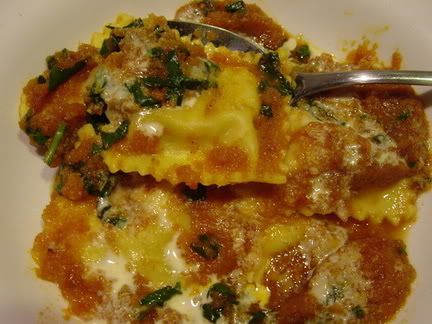
I have a soft spot for filled pastas and I will never resist a chance to try them. Recently Isetan supermarket in KLCC had a promotion that allows you to purchase filled pasta. The pasta are air flown from Italy and are usually distributed to restaurants in Malaysia. Splashie Boy bought a few varieties for us to try on Saturday night.

The first one we tried was the lobster and crab meat ravioli which we had with fresh tomato sauce, some cream and shredded basil. The filling was sweet and tasty but my sauce was a bit overpowering.

Image hosted by Photobucket.com

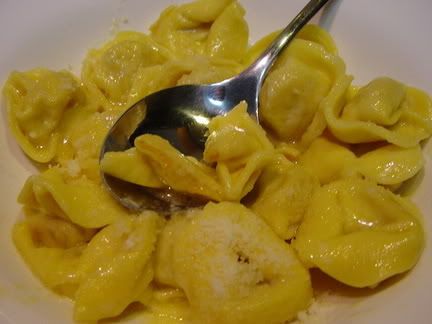
Since the tomato sauce was too strong for the ravioli, I decided to try a lighter sauce and made parmesan butter sauce for the pumpkin tortellini. Extremely simple recipe which just entailed melting butter in a pan, tossing the cooked pasta, freshly grated parmesan cheese and some water from boiling the pasta. Serve with more freshly grated parmesan cheese. The sauce went perfectly with the pasta. However, there was little pumpkin taste in the pasta.

Image hosted by Photobucket.com

We still have one more variety to try, a truffle stuffed pasta so I hope that will taste nice. I must admit that I was not wholly impressed with the taste of the pasta although the lobster one was quite nice. If you're mad about filled pasta like me, I recommend Fasta Pasta at Ikano Power Centre which has a few ravioli dishes. They even have a vegetarian one with avocado and portions are huge. The California Pizza Kitchen in KLCC does an upmarket ravioli with Portobello Mushrooms as a stuffing and a cream sauce. Toscana's in Desa Sri Hartamas does huge ones with a creamy mushroom sauce and a salad topping so you don't find it too rich.

Saturday, May 28, 2005

KyUrI CuCuMbEr

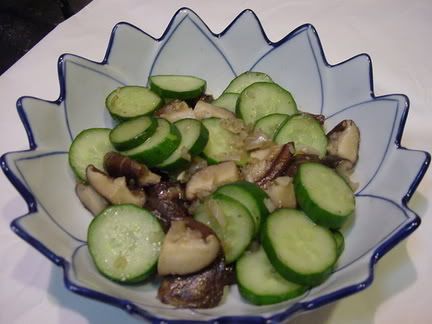
I love the coolness and crunchiness of cucumbers and one of my favourites is the Kyuri or the Japanese cucumber. I find the local cucumber a bit bland and some have a bitter aftertaste. It's totally distinct from the local cucumber with it's dark green skin and it is curved and skinny compared to the fatter local pale green cucumbers. The kyuri makes a wonderful healthy snack as you can eat it raw (no bitterness). Besides eating them crudite style, the Japanese mainly use kyuri to make vinegared dishes as an appetizer in their meal or pickles due to it's crunchy nature.

If I am not eating them raw, I like to stir fry them with fresh shitake mushrooms or sliced fish cake if they are available in my fridge. This softens the kyuri a bit but there is still a crunch to it. For the dish below, the minced garlic is fried till fragrant, then add the chopped fresh shitake mushrooms and kyuri to stir fry. The mixture is then left to simmer in a splash of water, some oyster sauce and soya sauce to taste. Usually I use 10-15 minutes but check on how cooked is the kyuri and the mushrooms as you may prefer it to be softer or crunchier. Dish up and enjoy.

Image hosted by Photobucket.com

Thursday, May 26, 2005

PoRRiDgE

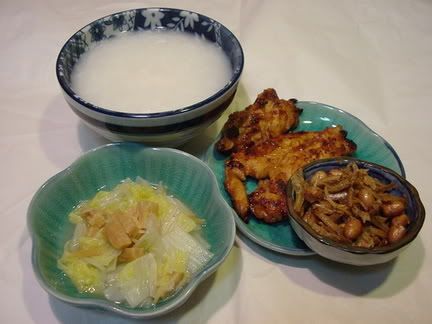
We recently had Teochew porridge with some dishes for dinner. I must admit that although I do eat porridge occasionally, I have never cooked it before at home. I got the inspiration to have Teochew porridge when I received some yummy deep fried ikan bilis (Malay for anchovies) and peanuts that my aunt made. (See the small little plate of them in the picture) They go perfectly with the plain and watery rice gruel.

The Teochews are famous for their porridge which they can eat throughout the day with a variety of salty accompaniments like kiam chai (salted vegetables), chai por (preserved radish), boiled salted duck eggs, fried salted fish and fried peanuts. They also eat porridge with braised duck (lou ark). The gravy from the braised duck is also used to cook fried bean curd (tau kua) and hard boiled eggs that all go perfectly with the porridge.

I tried to ask my mum how to cook the porridge but she said that it is all based on estimation so I tossed some rice grains in a pot, added some water and boiled it. After it has boiled, I stirred it and left it to simmer. I stirred the pot occasionally to ensure the mixture did not catch at the bottom of the pan and slowly the porridge got cooked. Once the rice grains had formed and softened, I turned the fire off.

Besides the fried ikan bilis and peanuts, we also had pan fried chicken fillets with a tomato sauce and Chinese cabbage with dried scallops. Not your usual fare in Teochew porridge but Splashie Boy is no great fan of salted vegetables and I did not have any salted duck eggs in the larder.

I had cut the Chinese cabbage in smaller pieces and soaked the dried scallops in boiling water. Peel and slice some garlic cloves and fry in a bit of oil. Once fragrant, put the cabbage in the wok and toss the mixture. Leave for 1-2 minutes and then add the dried scallops and their soaking liquid. Cover the wok and leave it to simmer for about 10-15 minutes. Season the vegetables to your taste with salt or soya sauce.

For the chicken fillets, marinate the chicken in a mixture of soya sauce, corn flour and a dash of pepper for about 30 minutes. Mix the seasoning with tomato ketchup, a dash of sugar, soya sauce and corn flour. Coat the chicken with the seasoning and pan fry the chicken until golden brown.

Image hosted by Photobucket.com

Tuesday, May 24, 2005

IMBB 15 - HaS my BLoG JeLLed Round Up

Elise of Simply Recipes has summarised all those wonderful entries for the IMBB 15 round-up in her website. Click here to drool over them like I did as they all look so good and enticing. I must admit that I am now itching to make some to cool down in this hot weather.
Great job organising and summarising the entries, Elise! Thanks again for a wonderful event. Hopefully this will be the first of many IMBB's I participate in.
Related Posts Plugin for WordPress, Blogger...